
Spring Clean Your Fluorescence Microscopy Setup
Spring has finally arrived in the UK, which means two things. First, there is a sudden and slightly suspicious appearance of sunshine. Second, people start looking around at things they’ve ignored all winter and think… well, I should probably sort that out.
The same applies in the lab.
Fluorescence microscopy setups have a habit of evolving in bits. A camera gets upgraded. Software gets refreshed. Filters get reviewed. Then somewhere in the middle of it all sits the illumination system, quietly carrying on as it always has, mainly because nobody has had the time or energy to ask whether it is still the best option.
If it still switches on, it tends to escape scrutiny. Which, to be fair, is how a lot of things survive in British workplaces.
Still, spring is a good time to take a fresh look.
Start with the bit doing the illuminating
Illumination is central to fluorescence imaging, but it’s usually not the first part of a system people think to review. It’s just there, doing its thing, until it starts needing bulb changes, warm-up time, extra maintenance, or the sort of workarounds that everyone in the lab knows by heart but nobody enjoys.
That is usually the moment when “perfectly usable” starts to mean “slightly annoying, slightly outdated, and held together by habit”.
A quick review doesn’t need to be complicated. Ask a few simple questions.
Is the output stable and repeatable from experiment to experiment?
Can you switch channels quickly and easily?
Is the system straightforward for different users to operate?
Does it fit your current applications, or just the ones you were doing five years ago?
And perhaps most importantly, is it actually helping, or quietly slowing you down?
These aren’t particularly glamorous questions, but they are useful ones.
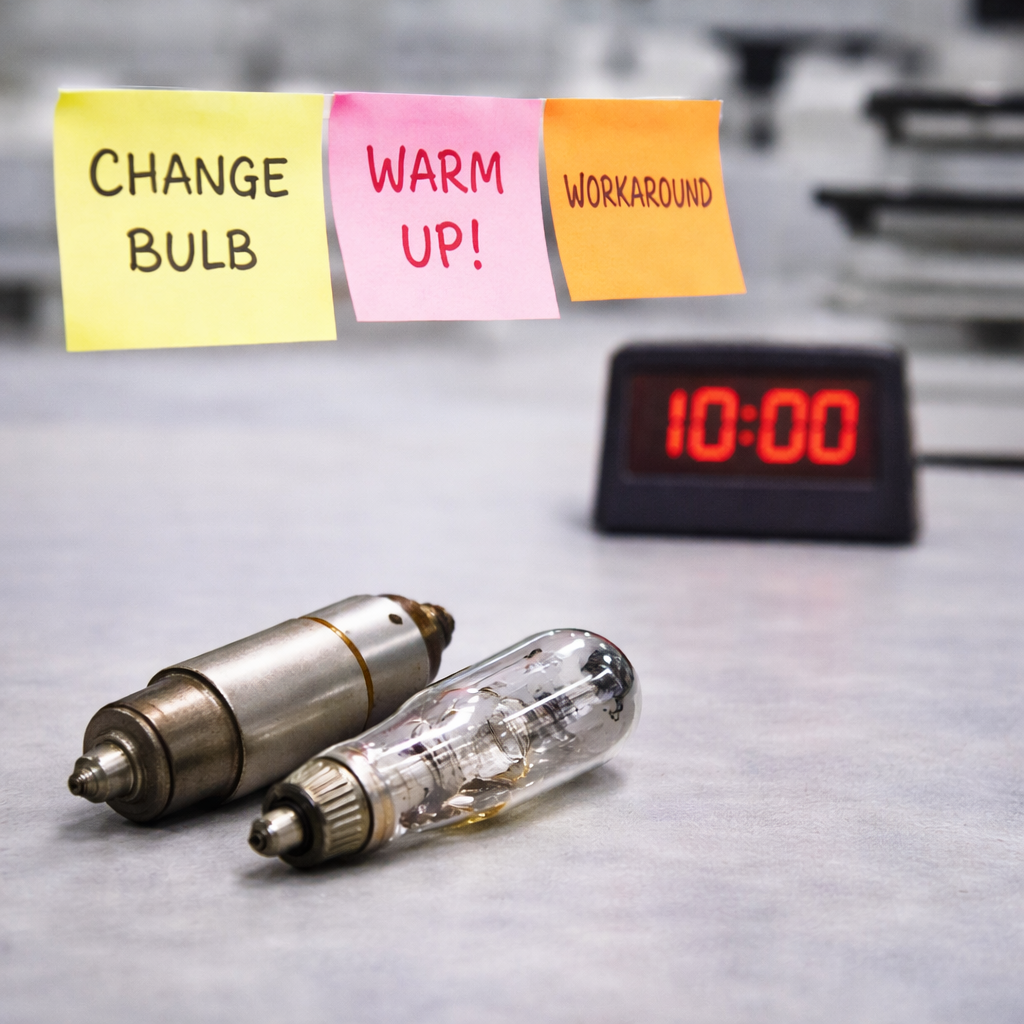
Is anything in your setup past its best?
For some labs, this is where older lamp-based systems come under the spotlight. Mercury and metal halide lamps have done a lot of heavy lifting over the years, but many now feel like the scientific equivalent of keeping a temperamental old boiler alive because nobody wants to deal with replacing it.
They still have a place in the history of fluorescence microscopy. The future, though, is looking elsewhere.
With increasing pressure to move away from mercury-containing systems, and with modern labs needing better stability, control and ease of use, older illumination technology is becoming harder to justify. Not because it was bad, but because better options now exist and the clock is ticking on what counts as sustainable, practical, and future-ready.
A spring clean is a good excuse to admit that some things are not “classic”. They’re just really, really old.
A fresher approach
Refreshing your setup doesn’t have to mean turning the lab upside down. Sometimes it simply means identifying the parts that create unnecessary friction and replacing them with something more stable, controllable and reliable.
For many labs, LED illumination offers exactly that. Less maintenance, no lamp changes, fast switching, greater control, and a setup that feels a lot more in step with modern imaging workflows.
Spring cleaning is really just about clearing out what no longer serves you.
And in some cases, that might include a light source that has been due a polite retirement for quite some time – and with the EU phase-out of mercury bulbs in February 2027, the clock really is ticking in terms of sorting out a more sustainable solution.
Written by Ben Furness / ben.furness@coolled.com / LinkedIn Profile