Thoughts of an Intern…
Hi everyone, my name is Abby and I’m a final year BSc Neuroscience student at the University of Southampton currently completing a Scientific Communications Internship at CoolLED, a field I look to enter after graduating. Much of my previous experience has been centred around the lab, experiments and data collection. Through all this however, my interest remains in learning more about the commercial side to science, the necessity of evidence-based research and crucially: how academia and industry interact to support scientific discovery.
As I come to the end of my third week at CoolLED, I’m in a reflective mood. Each day has reminded me that the cycle of learning never stops. I’ve gained valuable insight into an area of microscopy that at times can be overlooked – illumination. I hold my hands up, honestly, I may’ve been guilty of this. Being in the lab, it can be so easy to focus on the microscope and what you’re looking at, getting the experiment done and getting your data…
But what good is lots of data if it’s unreliable?
The Cost of Light
Here comes the challenge: “The Illumination Issue” as I like to call it.
Illumination can oftentimes be treated as a secondary consideration rather than the central factor that shapes imaging quality. This contributes to the issue and opens a door for a range of other issues. A very slippery slope indeed. Illumination directs affects data quality, reproducibility and something I’m going to focus on here: cell viability.
The fact is, poor illumination can oftentimes equal poor science.
Of all the issues that exist under this umbrella, there is one that stands as, arguably, the biggest issue – phototoxicity.
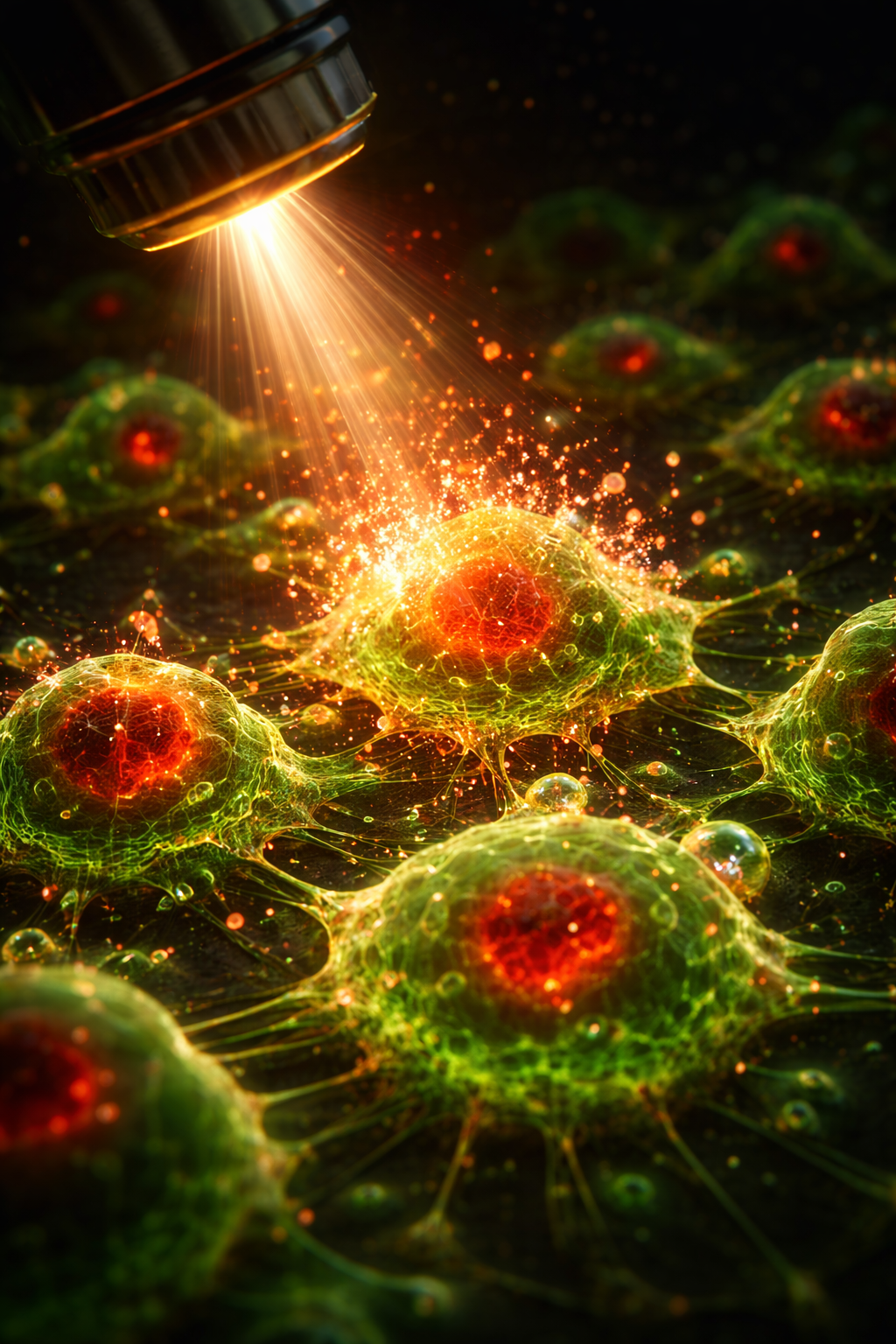
Prolonged light exposure can cause some troublesome results in live-cell imaging. It can generate reactive oxygen species, which can stress cells and lead to altered behaviour and even cell death. Not only does this limit the duration of the experiment, it compromises the biological relevance of the data.
Alongside factors such as variability between systems and maintenance concerns with legacy light sources, these challenges can cause major issues in research.
I hear you asking: where’s the good news Abby? What is the solution here? Well, look no further.
Let There Be Light
It became clearer by the day that success in imaging is about balance: having useful illumination that gives you exactly what you need to see, while still allowing you to maintain a healthy experiment. It’s about having “simply better control” (see what I did there). In my own experience, I’ve become quite familiar with a simple “on-and-off” mechanism. Recently, I spent five weeks working in a lab for my final year neuroscience research project, conducting a thrashing assay on C. elegans as a readout for motor and neural function. During this time, and even more so now, I began to appreciate the impact of phototoxicity: how over-illumination may have contributed to abnormal patterns of movement. How it may have caused general tissue damage and what this meant for my results. I can’t help but widen that perspective to the broader scientific community: what does this mean for medical research, optogenetics and microscopy as a whole?
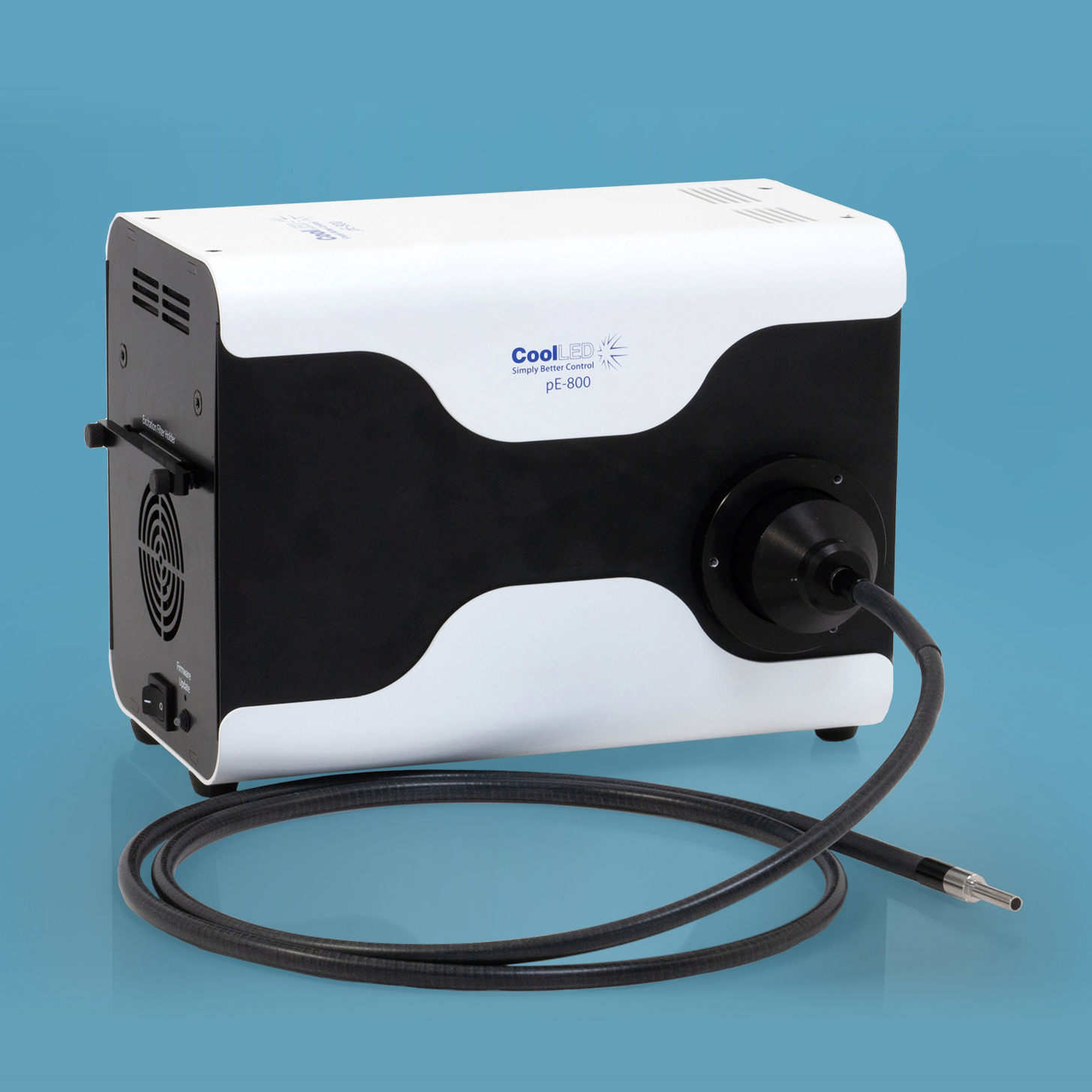
Encouragingly, advances in illumination technology can address these challenges and CoolLED stands as a leading contributor to this progress. One thing that’s become clear to me during my time here is how much emphasis CoolLED placed on developing precise and reliable fluorescence systems for biological research. As much as I’ve loved learning about the full range, there’s one system that really stands out to me: the pE-800. Back to phototoxicity, (yes, again) CoolLED systems are greatly favoured for helping to reduce it. The pE-800 is optimised for:
- Precise Intensity Control: This helps deliver the right intensity for the sample.
- Fast Switching: The pE-800 can switch on and off in microseconds (<7µs) perfect for high-speed imaging. This also means samples aren’t exposed to light excessively.
- Stable Output: Unlike mercury lamps, LEDs don’t fluctuate. This helps to prevent accidental overexposure also and provides consistent conditions for reproducible results.
- Targeted Wavelengths: The pE-800 possesses eight efficient LEDs that can be matched to specific fluorophores. This reduces unnecessary energy consumption, lowering phototoxic effects.
Interestingly, these features have been used to support research in a wide range of disciplines reflected in many recently published papers.
Simply Better Control
Although I still have a few weeks ahead of me, this experience this has really developed my appreciation for the importance of reliable light control and I’m excited to keep building on what I’ve learned. Illumination is not just a technical detail but rather a critical factor for robust data.
I’d consider our illumination issue officially solved! You can always count on CoolLED.
Written by Abigail Narh / LinkedIn Profile