Fluorescence microscopy used to be comparatively straightforward…
You had a sample. You labelled something interesting. You looked at it. You hopefully saw what you expected to see, and if you didn’t, you blamed the staining protocol, the microscope, the weather, or the person standing next to you who was ‘breathing too loudly’
But science, being science, rarely stays simple for long.
Today, researchers increasingly want to look at more than one thing at a time. Not just one protein. Not just one structure. Not just one marker sitting politely in its own channel. They want to understand how multiple biological features interact, overlap and organise themselves within the same sample.
This is where multiplexing comes in.
And yes, it sounds like the sort of word that should either belong in a cinema or a very complicated tax return, but let’s take a closer look…
What Is Multiplexing?
In fluorescence imaging, multiplexing means detecting several fluorescent labels within the same sample. Instead of asking, “Where is this one thing?”, researchers can ask more useful questions:
Where are these different markers?
How do they relate to each other?
Are they close together?
Do they change in healthy and diseased tissue?
And, ideally, can we answer all this without creating a data file large enough to frighten IT?
That is particularly useful in spatial biology and digital pathology, where understanding the organisation of cells and biomarkers within tissue can reveal far more than a single-channel image. Spatial biology, for example, is not just interested in whether a marker is present. It is interested in where it is, what it is near, and how different cells and structures relate to each other within intact tissue.
That context matters.
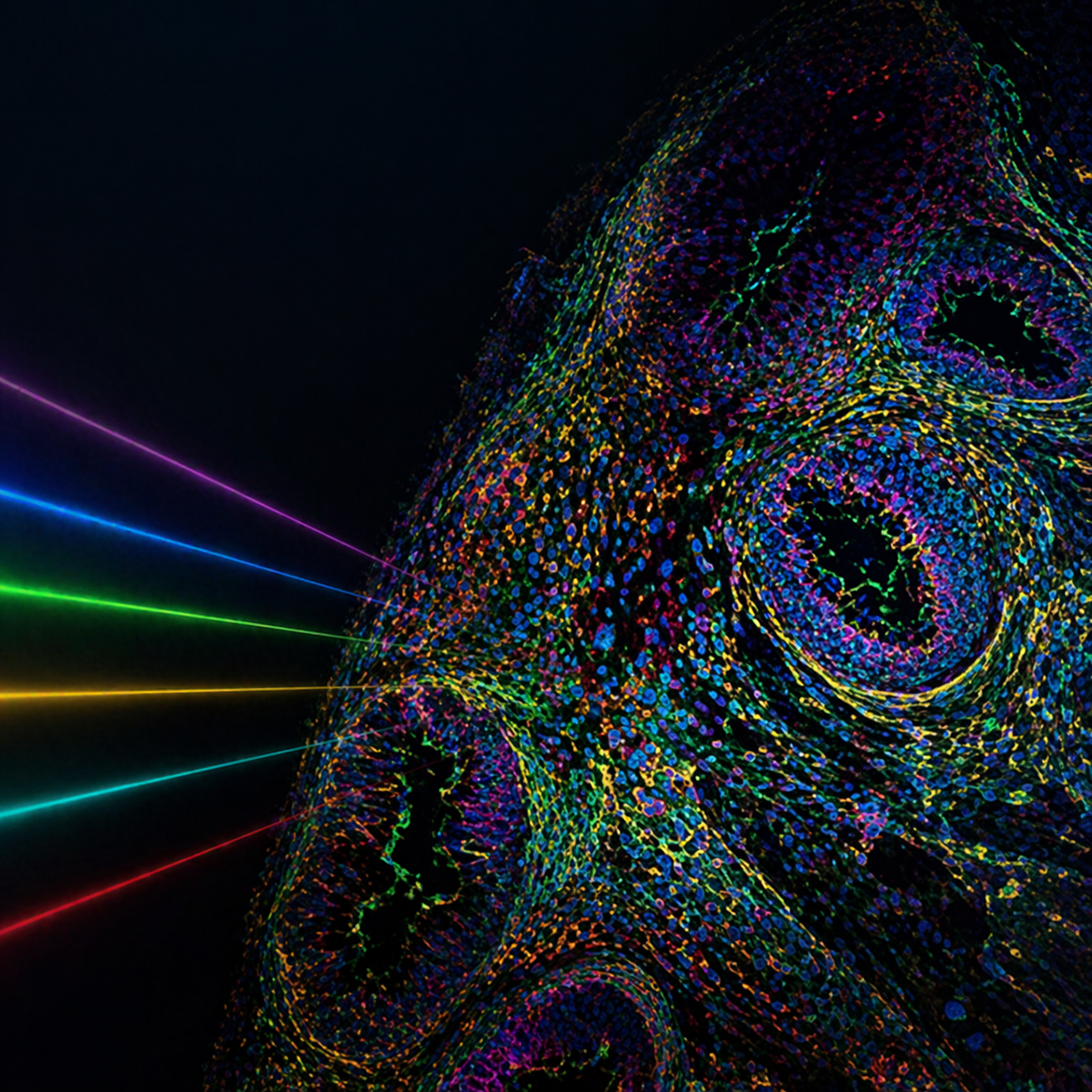
A single marker can tell you something useful. Multiple markers can tell you far more about the biological story unfolding in front of you. It’s the difference between seeing one suspicious footprint in the mud, and then switching the lights on to find the whole garden full of wellies, two stray dogs, and someone’s grandma holding a trowel.
The problem with adding more channels
Of course, adding more fluorescent labels is not as simple as throwing extra colours at a sample and hoping science applauds.
More channels mean more things to control. Fluorophores can overlap. Samples can bleach. Background signal can creep in. The wrong excitation wavelength can make a carefully planned experiment behave like a badly tuned orchestra.
For multiplex imaging to work well, the system needs precise control over wavelength, intensity and timing. The aim is to excite the right fluorophore at the right moment, while keeping the rest of the setup calm and cooperative.
This is where illumination becomes rather important…
Enter the pE-10
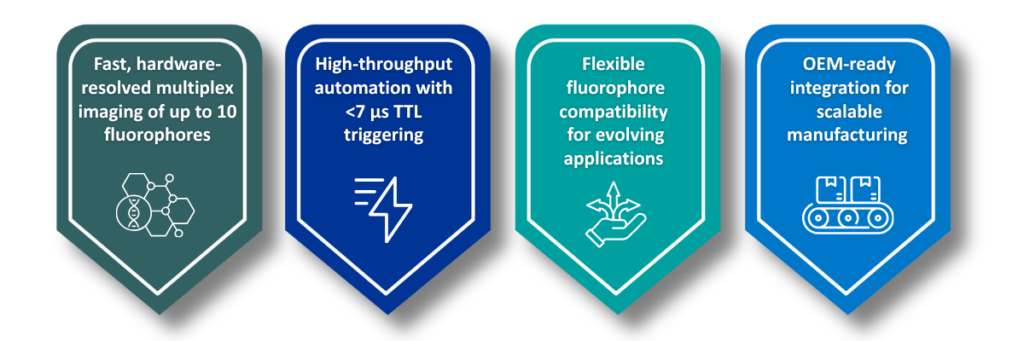
The CoolLED pE-10 has been developed for advanced multiplex fluorescence imaging, providing 10 LED channels with wavelength coverage from 365–850 nm.
It gives system builders the flexibility to match illumination more carefully to multiple fluorophores, supporting cleaner separation between targets and more reliable high-plex imaging.
When paired with the right filters and imaging system, the pE-10 helps provide a controlled foundation for applications such as spatial biology, digital pathology and other demanding fluorescence workflows.
Or, to put it less formally: when your experiment involves ten fluorophores, three spreadsheets and someone asking whether near-infrared counts as a colour, it helps if the illumination system knows what it’s doing.

Biology is Complicated, so Your LED Illumination Should Help
Multiplexing gives researchers the chance to see more from the same sample: more markers, more relationships and more biological context.
Of course, more channels can also mean more complexity. That is why controlled, repeatable illumination matters.
The pE-10 is designed to support advanced multiplex fluorescence imaging, giving system builders the wavelength coverage and control needed to keep high-plex applications moving.
Because biology was never designed to behave itself neatly, consistently and reliably… But your imaging system still can.
Written by Ben Furness / ben.furness@coolled.com / LinkedIn Profile