Why LED Illumination Holds the Key
Inspection cameras keep getting faster and pixels keep getting smaller, but if the photons are wrong, the tiniest scratch will stroll straight past your algorithms wearing an invisibility cloak.
Switch from outdated lamps to tuneable, fast‑switching LEDs and suddenly you have a toolbox full of spectral, timing and polarisation tricks that mercury could only dream of.
1. Match the LED peak to your photoresist
Many i‑line resists peak at 365 nm absorption, while g‑line and hybrid processes respond better around 430–450 nm. Selecting an LED that overlaps that curve maximises fluorescence contrast and banishes background glare. MicroChemicals GmbH
What to do: Choose an LED whose central wavelength lines up with the fluorescence peak of the resist or edge‑bead remover you’re actually using (430 nm for many i‑line resists, 365 nm for the classics).
Why it works: Maximum contrast, minimum stray light. You reveal micro‑voids and residues that a broadband lamp drowns in glare.
Use the CoolLED Amora System for your LED Illumination: Choose from a wide range of LEDs and Wavelengths (done at design and integration stage, not on the fab floor)


2. Strobe in micro‑seconds to freeze motion
Pulsing the LED for single‑digit µs bursts, synchronised to the camera exposure, removes conveyor‑belt blur without slowing the line. Industry case‑studies show strobing at <1 % duty cycle can deliver up to 6–8 × more peak light than continuous modes, perfect for wafers zipping along at metres per second. qualitymag.com
What to do: Pulse the LED in micro‑second bursts synced to the inspection camera.
Why it works: You stop motion blur without slowing the conveyor. Arc lamps hate fast pulsing; LEDs live for it.
Use the CoolLED Amora System for your LED Illumination: Built‑in TTL with switching inside a 20 µs TTL window at up to 5 kHz – fast enough to strobe every frame on a high‑speed tool.
3. Use polarised illumination to unmask overlay & stress defects
A dichroic polariser in front of the LED and a crossed analyser in front of the sensor can make hidden overlay errors or stress patterns flare up like neon. KLA’s polarised‑inspection patent details exactly how varying polarisation reveals phase‑contrast changes on the wafer surface. Google Patents
What to do: Pop a polariser over the LED head and cross‑analyse reflected light.
Why it works: Stress patterns and film wrinkling rotate polarisation, making overlay defects pop like neon graffiti.
Use the CoolLED Amora System for your LED Illumination: LED blocks accept off‑the‑shelf polarising adapters, zero redesign needed.

4. Mix normal and oblique angles for micro‑scratch detection
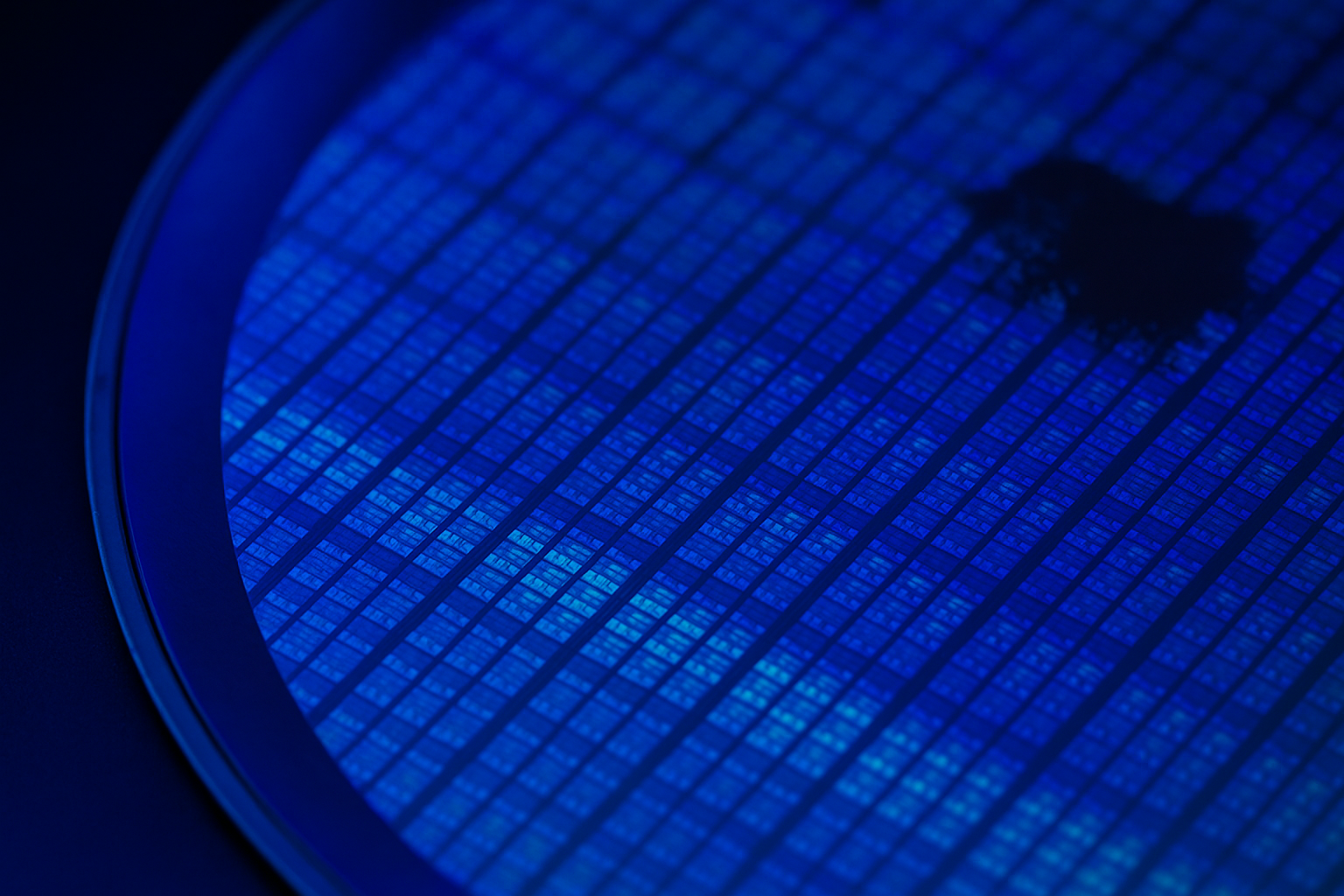
Dark‑field (shallow‑angle) illumination makes CMP scratches and residue sparkle, whereas a follow‑up bright‑field pass confirms whether you’re looking at dust or a real defect. Oblique illumination is a staple of optical dark‑field methods in semiconductor inspection. NDT.net
What to do: Mount two or more LED heads around the objective – one near‑normal, one at a shallow angle – and cycle them sequentially.
Why it works: Scratches often scatter light asymmetrically; shallow‑angle illumination makes otherwise invisible grooves sparkle like cat’s‑eye road studs. Normal incidence then confirms whether it’s a true scratch or just dust.
Use the CoolLED Amora System for your LED Illumination: The controller can drive multiple LED blocks independently (up to 16 channels), letting you toggle between “top‑down” and “glancing” light without extra electronics.
5. Lock illumination “recipes” to eliminate operator variability
Measurement‑systems‑analysis (MSA) guidance highlights that lighting repeatability is a major source of Gage R & R variation. Save a complete illumination profile – wavelength, intensity, pulse width – so every lot sees exactly the same photons, shift after shift. Vision Systems
What to do: Programme the inspection tool so each wafer type calls a saved set of LED wavelengths, intensities and pulse timings.
Why it works: Human memory is great for birthdays, terrible for three‑decimal‑place current settings. Recipes lock in the exact conditions that passed your last gauge‑R&R, eliminating “Friday‑night drift.”
Use the CoolLED Amora System for your LED Illumination: Amora’s API (USB, RS‑232 or Ethernet) lets you store and recall illumination profiles from the host PC or PLC – ideal for SCADA‑level automation.

That’s Amora!
The CoolLED Amora platform is essentially an LED pick‑’n‑mix for industrial inspection and quality control engineers: choose up to 16 wavelengths from 365 nm to 760 nm, programme pulse widths down to micro‑seconds, and monitor output in real time.
Final thought
Each of these tweaks is a low‑lift experiment that can translate directly into higher yield, faster throughput or fewer “why is this scratch invisible?” meetings.
Tune the peak, pulse with intent, polarise for secrets, manage the heat, and let feedback keep you honest – your wafers (and your bonus scheme) will thank you. If you need an LED Illumination System for Industrial Inspection, flexible enough to try the lot, then find out more by clicking the button below.
Written by Ben Furness / ben.furness@coolled.com / LinkedIn Profile