
Why packaging is becoming more complex
The semiconductor industry has always had a gift for making extremely difficult things even more difficult.
Modern electronics keep getting smaller, faster and more powerful, because apparently nobody in the semiconductor industry has ever looked at a difficult challenge and thought, “That’s probably enough now.” Advanced packaging means more components squeezed into tighter spaces, with more connections, more layers and less room for error.
A tiny defect, a slight misalignment, a weak bond or a barely visible residue can all cause problems. Not in a dramatic, sparks-flying, alarm-bells way. Often in the much more annoying way: lower yield, inconsistent performance, reliability issues or a fault that turns up precisely when nobody wants it to.
So inspection systems need to find increasingly subtle details across increasingly complex structures.
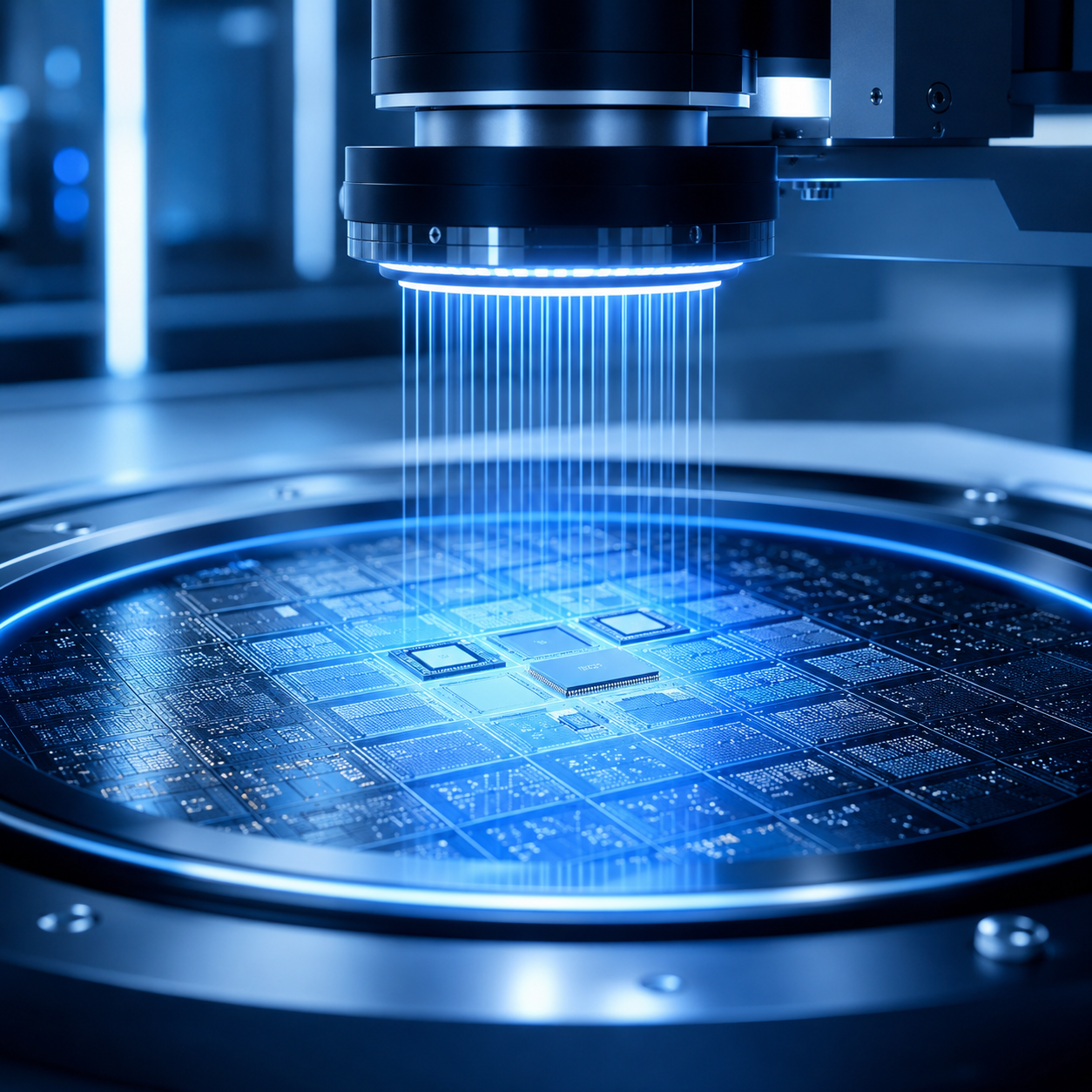
Why illumination matters
When people talk about inspection, the camera usually gets the attention. Then the optics. Then the software, which gets to use exciting words like “algorithm” and “deep learning” while everyone nods thoughtfully.
Illumination is often treated like the helpful assistant in the background but, in optical inspection, the light source can decide whether a feature is obvious, faint, misleading or completely invisible.
Different materials and defects respond differently to different wavelengths. A surface mark that barely shows up under one colour of light may stand out clearly under another. Fine traces, coatings, bonding features and material boundaries can all become easier or harder to detect depending on how they’re illuminated.
So the question isn’t simply, “Is it bright enough?”
That’s a perfectly reasonable question if you’re looking for your keys under the sofa. It’s less useful when you’re inspecting a high-value microelectronics package full of features you can barely see without expensive machinery and a calm nervous system.
The better question is: what light actually helps the system see what matters?
Why LEDs suit advanced inspection systems
LEDs allow system builders to select specific wavelengths rather than relying on one broad light source and hoping the useful bits are somewhere in there. That makes it easier to tune illumination around the material, defect or structure being inspected.
They’re also stable and repeatable, which is rather important when your inspection system needs to produce consistent results across samples, production runs and sites. If the light source drifts, the measurement can drift with it. At that point, you’re not inspecting so much as politely guessing.
Fast electronic control is another advantage. LEDs can be switched and synchronised with cameras, sensors and automated workflows, supporting multi-wavelength inspection and tightly timed imaging routines.
And because LEDs avoid many of the warm-up, heat and replacement issues associated with traditional lamps, they’re also more practical for systems where downtime is not a charming little break, but an expensive problem.

Where CoolLED fits
For CoolLED, the link to ECTC is through OEM illumination for inspection, metrology and analysis systems.
Advanced packaging inspection doesn’t need “some light”. It needs controlled illumination designed around the instrument, the optical path, the timing requirements and the thing the system is trying to detect.
That might mean selected UV, visible, NIR or SWIR wavelengths. It might mean multiple independently controlled channels. It might mean fast triggering, fibre delivery, compact integration or a custom configuration that fits neatly into a larger machine without causing engineers to stare silently into the middle distance.
CoolLED’s OEM illumination platforms are built for exactly this sort of challenge: providing precise, repeatable, application-specific light for systems where “close enough” is not a specification.
Because when you’re inspecting advanced semiconductor packages, the goal isn’t just to shine light at small things and hope they confess.
It’s to use the right light, in the right way, so the system can see what actually matters.