Plan Your Mercury-Free Transition
Countdown to EU RoHS exemption end date
The EU RoHS exemption for mercury in fluorescent lamps comes to an end on 24 February 2027.
Start planning now to reduce uncertainty around bulb supply, downtime and future system support.
Start the conversation
Tell us who you are and we’ll help you take the next step towards mercury-free illumination.
A Day in the Life of a Lab Manager Preparing for the Mercury Bulb Phase-Out
You wake up. You make coffee. You check your emails. You briefly consider whether today might be the day you finally clear the terrifying pile of “things to look at later” on your desk.
Then someone mentions mercury lamps.
More specifically, someone mentions the EU phase-out affecting mercury and metal halide lamps, and suddenly your calm morning has acquired a small but persistent background hum of concern.
You’ve heard about it vaguely. Something about 2027. Something about lamps becoming harder to buy. Something about exemptions, restrictions, timelines, replacement planning and, quite possibly, paperwork.
Naturally, you do what any sensible lab manager or facility manager would do.
You search online…
… Did Searching Online Help?
Yes, in the same sense that tipping an entire filing cabinet into a swimming pool also technically ‘helps’ you “access information”. There are directives, exemptions, amendments, dates, interpretations and just enough ambiguity to make you wonder whether you’ve misunderstood the entire thing.
What you really need is a clear timeline, not a legal maze, and not a 94-page document with the emotional warmth of a printer manual. Just a practical explanation of what is changing, when it is changing, and what it means for fluorescence microscopy users still relying on mercury or metal halide illumination.
Thankfully, that’s where the CoolLED No More Mercury page comes in.
First problem: what’s actually happening?
The first step is understanding the timeline.
The EU mercury lamp phase-out is already changing the long-term availability of traditional mercury-based illumination. For many microscopy users, the key issue isn’t necessarily whether existing systems can still be used. It’s whether replacement bulbs will remain easy, affordable or even possible to source as availability reduces.
That makes planning important, especially for shared imaging facilities, research departments, clinical environments and laboratories where a failed lamp doesn’t just cause inconvenience. It can delay experiments, disrupt bookings and create the sort of calendar chaos usually reserved for school nativity plays.
Our ‘No More Mercury’ hub sets out the key dates and practical implications, so you can quickly understand what the phase-out means without needing to become a part-time regulatory historian.

Second problem: how many bulbs do we actually have?
This is the point where many labs discover that their bulb stock system is less “carefully managed inventory” and more “a cupboard, some boxes, and the general memory of someone called Dave”.
You might know roughly how many bulbs are in the building. You might know roughly how often they’re replaced. You might know that someone ordered some last year, unless that was filters, or possibly printer toner.
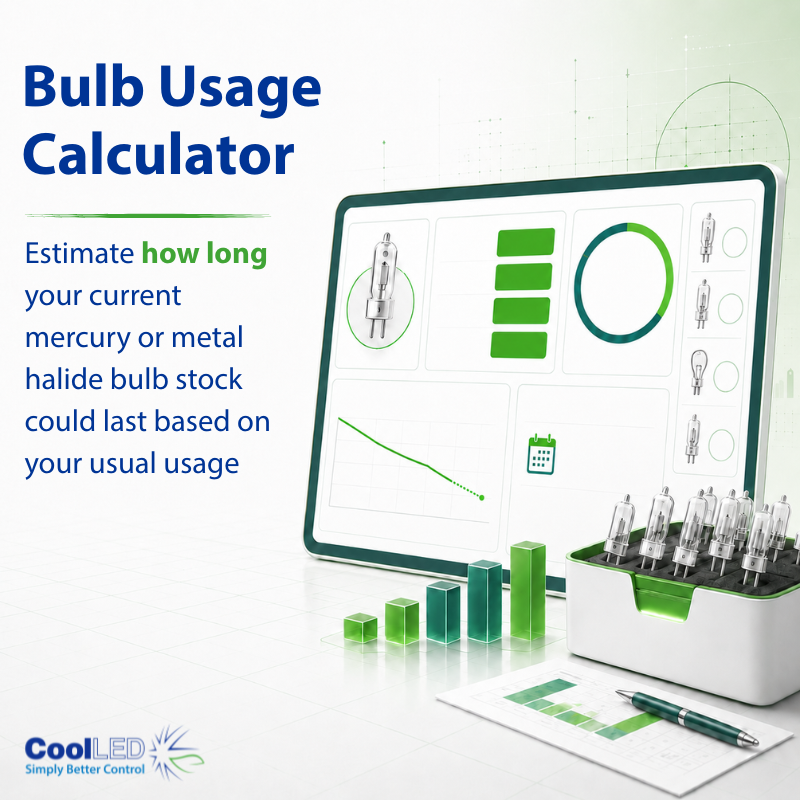
This is where our bulb stock calculator becomes useful.
By entering a few basic details about your current stock and usage rate, you can get a clearer idea of how long your bulbs might last. It’s not a lamp lifetime predictor, and it won’t tell you the exact moment a bulb will fail, because sadly science hasn’t yet produced a spreadsheet that can sense impending doom. But it can help you understand whether you’re sitting comfortably, cutting it fine or heading towards a very awkward conversation.
Third problem: what else needs thinking about?
Do you need to review microscope compatibility? Budget timing? Procurement processes? User training? Application requirements? Preferred wavelengths? The number of systems affected across your facility?
At this point, your to-do list may begin developing its own gravitational pull.
That’s why our ‘No More Mercury’ readiness quiz exists.
It walks through the basic considerations and helps highlight areas you may need to review before switching from mercury or metal halide lamps to LED illumination. Rather than starting with a blank page and a vague sense of unease, you get a more structured view of what needs attention.
For lab managers, facility managers and microscopy leads, that can make the process much easier to explain, plan and prioritise.

Fourth problem: what about the awkward specific questions?
Even after checking the timeline, estimating bulb stock and reviewing readiness, there may still be detailed questions.
Can LED illumination replace my current lamp directly? What happens if I use multiple fluorophores?
Will my users need retraining? What are the benefits beyond avoiding mercury lamps? How do I compare LED alternatives with the systems we already have?
These are reasonable questions and our FAQ section on the No More Mercury page is designed to help with exactly that. It answers common questions around the mercury lamp phase-out, LED alternatives, practical replacement considerations and what laboratories should be thinking about now.
Final problem: getting buy-in
You may understand the issue. You may know the risks. You may have a sensible replacement plan. But someone else still needs to approve it.
This usually means explaining why switching to LED illumination isn’t just a nice upgrade. It’s a practical response to changing lamp availability, ageing technology and the need for stable, controllable, long-term fluorescence illumination and can save you a considerable amount of money in the long run.
Our No More Mercury resource pack gives you supporting information to help make that case internally. Whether you’re speaking to senior management, procurement, finance teams or other stakeholders, it helps frame the switch to LED illumination in clear, practical terms. Because “we should probably do something about this before it becomes a problem” is true, but rarely enough on its own to unlock a budget.

Start preparing now
The mercury and metal halide lamp phase-out doesn’t have to become a last-minute scramble.
With a clear timeline, bulb stock calculator, readiness quiz, FAQ section and supporting resource pack, our No More Mercury hub is designed to help labs and imaging facilities understand the risks, plan ahead and make the transition to LED illumination with confidence.
So, if you’ve heard about the phase-out but haven’t quite worked out what it means for your lab yet, now is a good time to start… Ideally before Dave decides to reorganise the bulb cupboard again.