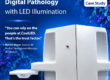
Download the New Green Light Laboratories Independent Case Study
Investigating the real-world running costs associated with metal halide bulbs, compared with CoolLED LED Illumination
Five months left. The time for “we’ll get to it” is over.
If your facility still relies on mercury or metal halide illumination, this is a big deal and we know it won’t feel small. Change is disruptive, it can feel expensive, and nobody wants another urgent equipment decision on their plate. But with the EU RoHS exemption ending on 24 February 2027, this has moved beyond awareness. It’s time to make a plan.
You’ve had time to understand the problem. Now you need a route through it.
Over the past year there’s been time to read the guidance, check the FAQs, use the calculator and think through what a transition away from mercury might involve for your microscopy setup.
That work mattered. It still does. But with only around five months until the exemption ends, staying in research mode now creates a different kind of problem. Budgets need approval. Equipment choices need making. Shared facilities need time to plan installations without causing unnecessary disruption.
Your current light source won’t suddenly stop working on 24 February. But the market around mercury-containing lamps is changing, and waiting until bulb supply becomes painful is a much harder way to handle this.
If you’ve been thinking, “we know this is coming, we just haven’t quite got to it yet”, you’re definitely not alone. But this is the point where that conversation needs to become a plan.
The running costs tell a pretty clear story
One of the hardest parts of this transition is often persuading the people who control the budget. That’s where the new Green Light Laboratories study helps. Using real-world energy measurements at the Wolfson Bioimaging Facility, University of Bristol, it compared a 120 W metal halide system with CoolLED pE-300lite and pE-400max LED Illumination Systems.
It’s about running costs, lamp replacements, time lost to maintenance, and making a stronger funding case when you do need to ask for money.
Want the full detail, methodology and results from the latest September 2026 Green Light Laboratories report?
Read the full case studySource: Green Light Laboratories, Fluorescence Microscopy: Light Source Running Costs, September 2026. Results are based on the systems, operating assumptions, electricity tariff and bulb costs used in the study. Actual savings will vary by facility.
Don’t frame LED as just another expense
We know this transition can feel daunting. If a facility has relied on the same illumination setup for years, changing it can feel like hassle, risk and cost all rolled into one.
But if mercury or metal halide is part of your setup, the change is coming anyway. The latest independent figures show that moving to LED can help turn a forced transition into something much more positive, with lower energy use, no bulb replacements and the potential to save thousands over the longer term.
There’s still time to do this properly. There isn’t much time left to keep putting it off.
Plan Your Mercury-Free Transition
Countdown to EU RoHS exemption end date
The EU RoHS exemption for mercury in fluorescent lamps comes to an end on 24 February 2027.
Start planning now to reduce uncertainty around bulb supply, downtime and future system support.
Start the conversation
Tell us who you are and we’ll help you take the next step towards mercury-free illumination.