What actually makes something fluoresce?
There’s something wonderfully odd about fluorescence. In daylight, a scorpion looks exactly as you’d expect: dark, armoured and slightly terrifying. Shine ultraviolet light on it, though, and the whole thing can suddenly blaze blue-green, as if someone’s gone over it with a neon highlighter.
And scorpions are nowhere near the only ones. Corals fluoresce. Some sharks do it. Platypus fur has been found to fluoresce green-cyan under ultraviolet light. Some chameleons even have tiny bony structures that shine through their skin. There’s a whole layer of colour in nature that we normally never see.
So what’s actually happening?
Fluorescence isn’t the same as bioluminescence. A firefly makes its own light through a chemical reaction. Something fluorescent needs light to fall on it first.
Certain molecules can absorb that incoming light energy and then release some of it again at a longer wavelength. That’s how invisible ultraviolet light can go in and visible blue, green or red light can come back out. It’s physics, but it feels suspiciously close to magic.
Nature has found all sorts of ways to make use of it. Some corals contain fluorescent proteins that turn blue or ultraviolet light into brilliant greens, reds and oranges. Fish and sharks can have fluorescent patterns that become much easier to see under the right light. In some animals those colours may help with signalling, camouflage or finding prey. In others, fluorescence may simply be a side effect of the chemistry they’re made from.


Nature has gone slightly mad with it
Scorpions are a perfect example. Their outer covering contains compounds that fluoresce strongly under ultraviolet light, but scientists still debate why. It may help them respond to light levels, or it may not be there “for” anything at all. They may simply happen to glow like radioactive sweets.
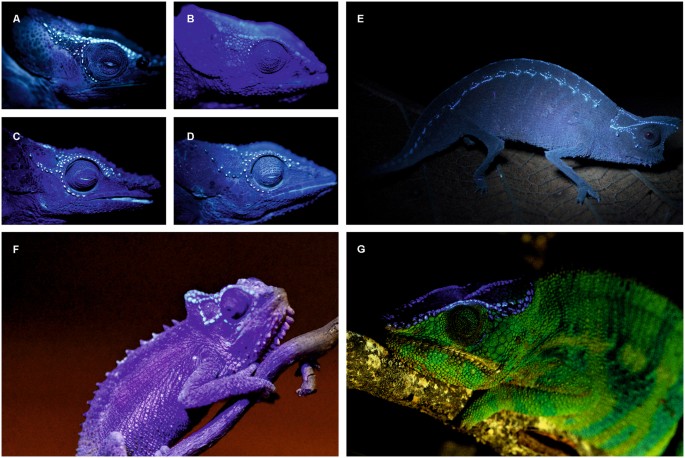
Then there are chameleons. In some species, bone sits beneath particularly thin patches of skin, and because bone naturally fluoresces, little blue spots appear when ultraviolet light reaches it. The animal is basically using its own skeleton as decoration. Frankly, showing off feels like the most reasonable explanation, even if science would like us to be a bit more serious about it.

Then humans borrowed the trick
Eventually, people realised that fluorescence could do more than make animals look astonishing. If something tiny could be made to fluoresce, it could become much easier to find.
By the early 20th century, scientists were experimenting with fluorescence microscopy. Later, fluorescent dyes were attached to antibodies so particular structures in cells and tissues could be made to light up.
Then came Green Fluorescent Protein, or GFP, originally isolated from the jellyfish Aequorea victoria. Scientists eventually learned how to use the GFP gene in other organisms, letting living cells make their own fluorescent marker. Proteins, cells and processes that had been effectively invisible could suddenly be followed in living systems.
The best bit is that none of these colours appeared when we discovered fluorescence. They were there all along. Scorpions were glowing under ultraviolet light before ultraviolet lamps existed. Corals were quietly changing one colour of light into another long before humans were around to notice.
What changed was us. We found ways to see light our eyes normally miss, and then worked out how to use the same phenomenon to reveal things inside cells that had always been hidden too.
There’s something lovely about that. The natural world didn’t suddenly become stranger when we discovered fluorescence. We just got better at noticing how strange it already was.
And chances are, there’s still plenty glowing quietly away that we haven’t noticed yet.