
Learn how the pE-400max played a pivotal role in recently published research paper
Single-molecule studies are valuable for understanding the intricacies of biological systems, however existing techniques face various challenges including diffraction limits, limited temporal resolution, and photobleaching.
Seeking to overcome these challenges, a new research paper titled “Hexagonal Plasmonic Arrays for High-Throughput Multicolor Single-Molecule Studies”, evaluates an innovative solution for advancing single-molecule detection using nanophotonic biosensors.
What are nanophotonic biosensors?
These biosensors leverage the principles of nanophotonics (the interaction of light with nanometer-scale structures) to detect biological molecules, and are especially renowned for their high sensitivity against a high background.
Here, the researchers from The Institute of Photonic Sciences in Barcelona, Spain, explore a subset of these biosensors known as ‘Antenna-in-box’ sensors, and have created a high-throughput design in the form of a hexagonal close-packed array.
Biosensors in action
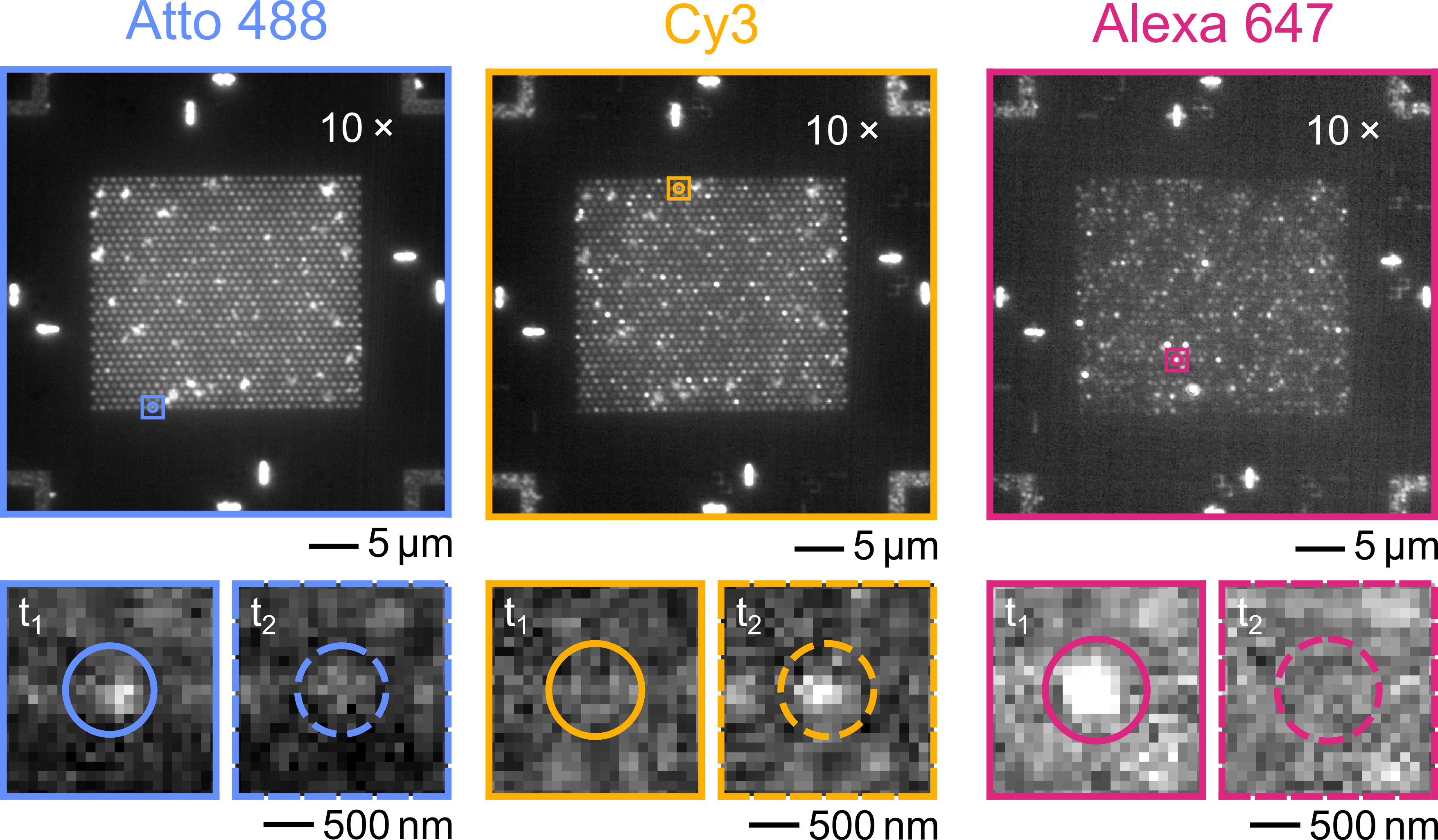
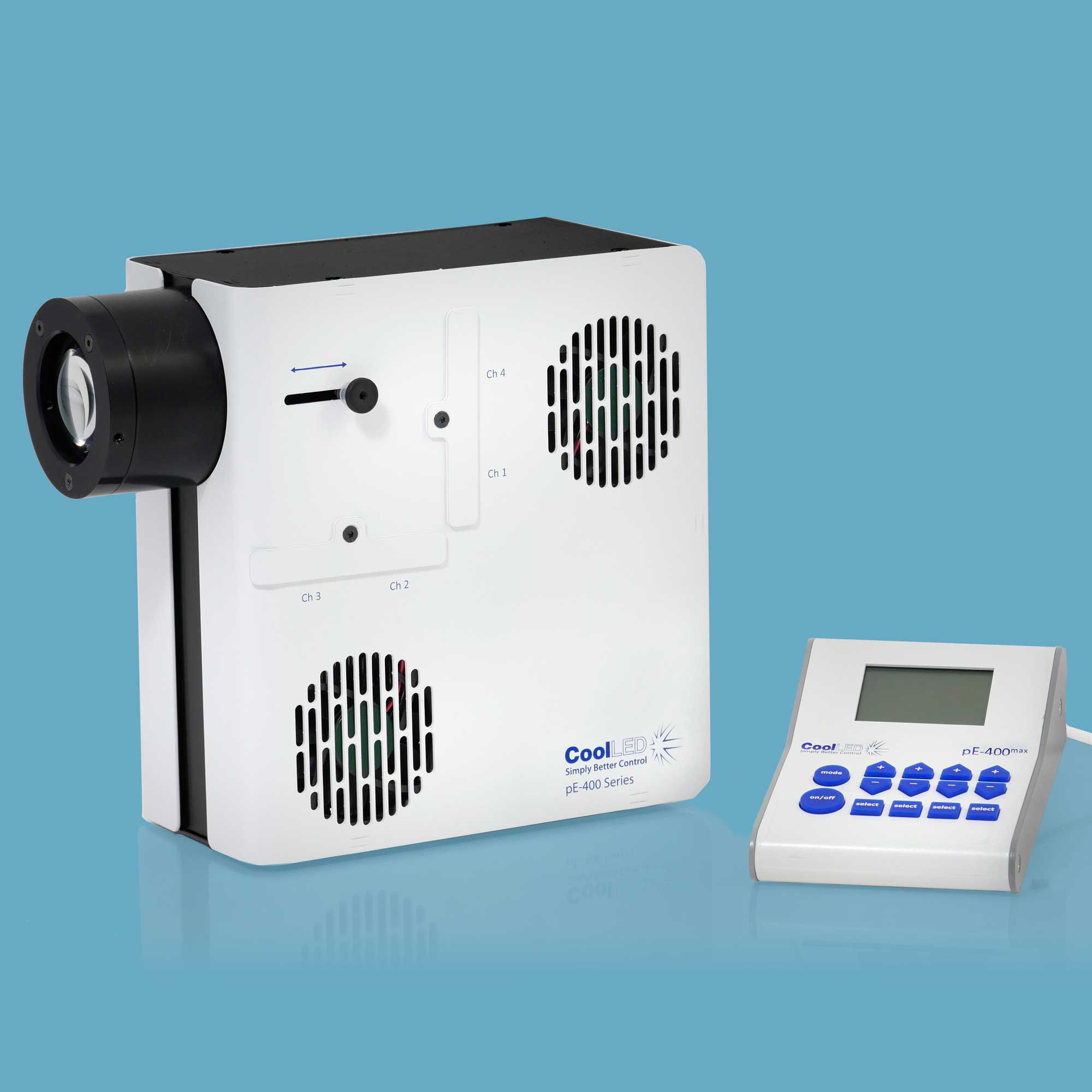
To evaluate the novel biosensor system, the researchers employed a widefield fluorescence microscope setup and a three-colour sequential imaging protocol (Figure 1). Illumination was provided by the CoolLED four-channel pE-400max, which excited fluorophores Atto 488 (via the blue LED), Cy3 (green-yellow-red LED), and Alexa Fluor 647 (red LED). A quad-band filter set optimised for LED light sources ensured optimum imaging in each channel with excellent spectral separation.
The illumination was also precisely controlled through TTL triggering directly from an sCMOS camera. The high-speed TTL triggering capability ensured the light source did not limit the speed of the setup, enabling high-speed imaging and therefore high-throughput data acquisition.
The pE-400max proved ideal for this application due to its four independently controlled channels, tailored to commonly used fluorophores. The ability to control each channel individually via TTL allowed seamless synchronisation with the camera. Additionally, the intensity of each channel could be modulated from 0–100%, enabling precise signal balancing for multi-colour imaging and enhancing the overall versatility of the system.
In conclusion: This research has successfully proved this novel biosensor concept, achieving single-molecule imaging at micromolar concentrations, offering a high throughput combined with high sensitivity in a multi-colour imaging setup. Currently, the complexity of manufacturing this highly specialised biosensor array presents a barrier to overcome before we see this technique become popular for multi-colour single-molecule imaging applications – but there are solutions to this on the horizon.
About the pE-400max LED Illumination System
- 4 channels can be individually controlled, with any simultaneously running at 100%
- Broad spectrum from 365-635 nm, ranging from DAPI through YFP to Cy5.
- Seamless integration into compatible third-party imaging software and cost-effective high-speed imaging with pE-6501 USB controlled TTL trigger box
- <10 µs global and channel TTL triggering for high-speed imaging
- Optimised irradiance control in 1% steps (0-100%)
- Sequence Runner for software control with speed of TTL
- Optional inline excitation filter holders: no moving parts for high-speed imaging
- Simple control pod for intuitive manual operation
- pE-400max LightBridge graphical user interface (GUI) for intuitive digital operation
- Direct fit available for higher irradiance with selected/all major microscope models
- Light delivery also available via liquid light guide
Plus all the benefits afforded by LED Illumination Systems, such as sustainability and longevity.

CoolLED specialises in LED microscope lighting and, since our team of four introduced the first commercially available LED microscope illuminator in 2006, we have led the way in designing and manufacturing cutting edge LED Illuminators for Microscopes using the latest technology.