
Beyond the Visible: NIR and SWIR LED Illumination
Visible light remains fundamental to many imaging systems, but it is no longer the boundary of what advanced illumination can provide.
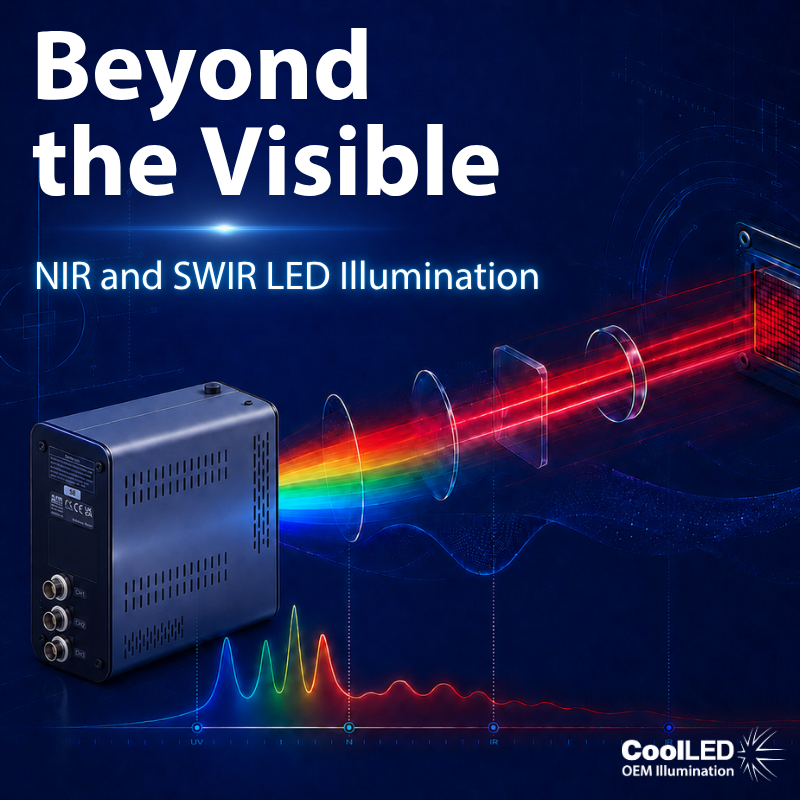
As industrial and life science applications become more specialised, system designers are increasingly moving beyond the visible spectrum. Near-infrared (NIR) and short-wave infrared (SWIR) wavelengths can reveal information that visible light cannot easily reach, helping imaging systems detect hidden defects, penetrate deeper into tissue, identify materials, enhance contrast and support more sophisticated measurements.
For OEM instrument developers, this presents both an exciting opportunity and a technical challenge. Longer-wavelength illumination must be more than simply achievable; it needs to be stable, repeatable, controllable and practical to integrate.
Why Move Beyond Visible Wavelengths?
In advanced imaging, illumination is not always used simply to make a target brighter. More often, it is used to create meaningful contrast. Different materials, surfaces and biological samples interact with wavelengths in different ways, varying in how they absorb, reflect and transmit light depending on their composition, structure or condition.
The correct wavelength can help reveal details that may be difficult or impossible to see under standard visible illumination, including:
content
type
defects
uniformity
structures
Applications in industry and life sciences
Industrial imaging
In industrial imaging, NIR and SWIR wavelengths can be especially valuable for inspection and analysis and measurement.
In semiconductor and metrology applications, longer wavelengths can support imaging below the surface of some materials such as Si based semiconductor wafers and devices, helping detect cracks, inclusions, bonding issues and other hidden defects. In materials sorting, they can help distinguish between plastics, coatings or other materials that may look similar under visible light.
Moisture detection is another important example. Water has strong absorption bands in parts of the NIR and SWIR spectrum, making longer wavelengths useful for food inspection, drying process monitoring, contamination detection and coating assessment.
Life science imaging
Life science imaging also benefits from moving beyond the visible range. Biological samples can be affected by scattering, absorption and background autofluorescence, all of which can mask signals making them harder to detect. Using NIR and SWIR wavelengths can improve contrast in complex samples and are relevant to areas such as preclinical imaging, deep tissue imaging, vascular imaging and tumour research.
Additionally, with the increasing development of specialist fluorescence probes, NIR/SWIR imaging opens up the available spectrum, thus allowing more fluorescent labels to be captured in a single acquisition and reducing “crowding” of the spectral space.
Across both sectors, the principle remains the same: longer wavelengths can help imaging systems access information that visible light may not clearly reveal.
Why NIR and SWIR Imaging Is Technically Difficult
Extending illumination into the NIR and SWIR regions is not as straightforward as adding another LED to a product. Once systems move beyond approximately 1100 nm, specialist detector technologies are often required, and the illumination itself becomes more demanding. Optical power, thermal management, efficiency, coupling, beam shaping and long-term stability all require careful consideration. The optical path is equally important, as lenses, fibres, filters and other components can behave differently across extended wavelength ranges.
A solution that performs well at a visible wavelength may need to be adapted, redesigned or entirely rethought for a further red-shifted wavelength.
From Possible to Practical
At CoolLED, OEM projects often start with an application challenge rather than a fixed product specification. An instrument developer may require a particular wavelength combination, optical output, coupling method, timing behaviour or mechanical format. In many cases, the requirement does not sit neatly within a standard illumination product, which is where application-led engineering becomes important.
The challenge is not only to extend wavelength coverage, but to ensure those wavelengths provide a genuine advantage within a real system. This means considering optical delivery, control, stability, thermal performance, communication, mechanical integration and long-term manufacturability from the outset.

A More Specific Future for Illumination
As advanced imaging becomes increasingly specialised across industrial and life science applications, LED illumination systems need to evolve with it.
Expanding into NIR and SWIR is not about chasing bigger numbers on a wavelength chart. It is about helping imaging systems reveal information that was previously difficult, unreliable or impractical to access. In advanced imaging, the real question is not simply how much light a system can deliver, but what that light makes possible.