
A First Look at the pE-300opto at SfN 2025
The Society for Neuroscience meeting is always a fantastic opportunity to connect with the neuroscience community, and understand what they need from LED Illumination Systems – both on the academic side and our partners in the industry too.
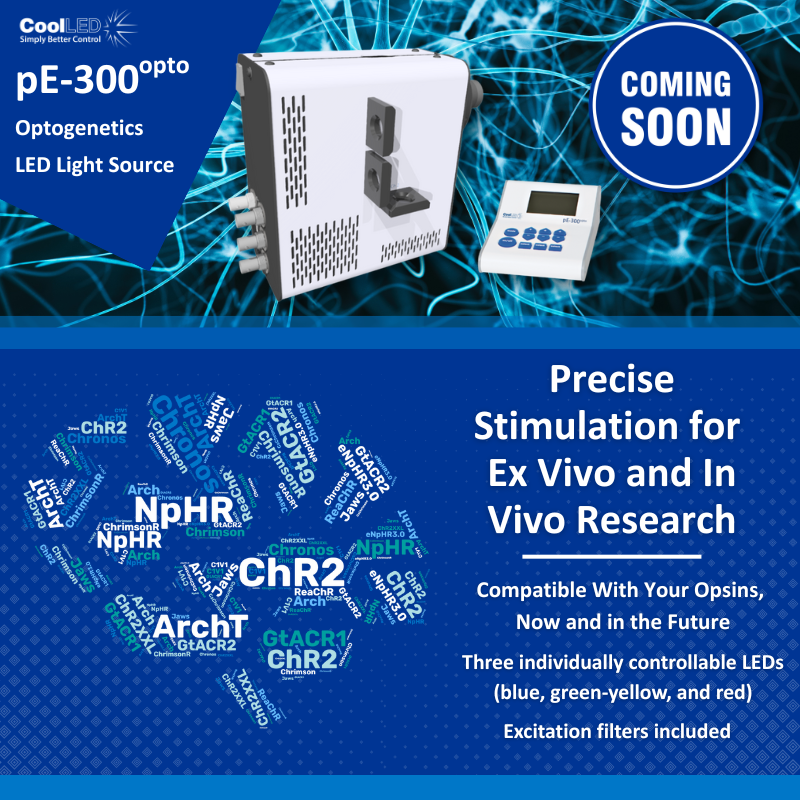
This year was particularly special – not just because the famous English rain followed us all the way to a drought-ridden San Diego (you’re welcome, California!). SfN 2025 also marked the first public showing of our new optogenetics light source prototype, the pE-300opto, and the response was overwhelmingly positive. Seeing how feedback from neuroscience experts has translated into a real product on our booth, and genuine interest from our booth visitors, was incredibly rewarding – and we’re excited to share that it’s due for full launch early next year.
A First Look at the pE-300opto
- Tailored opsin coverage – Blue (470 nm) and green (550 nm) LEDs support widely used opsins such as ChR2 and NpHR, while the red (635 nm) LED enables researchers to utilise red-shifted opsins such as Jaws and ChrimsonR to further advance their experiments with deeper tissue penetration or multi-opsin experimental designs.
- Precise and Repeatable – High-speed (<10 µs) and precise control of light intensity and timing is achieved through individual channel TTL triggering, ensuring that every pulse during a stimulation protocol is identical and reproducible.
- Designed for biologists – We’ve prioritised ease of use so researchers can focus on the biology. The pE-300opto has a simple interface and includes excitation filters matching the LEDs to a range of opsins. Slot the filters into the Light Source filter holders, and configure the LEDs at the touch of a button (without the need to navigate optical filter complexity).
- Flexible applications – Whether performing in vivo experiments using a fibre, or illuminating tissue slices under a microscope, the pE-300opto can do both. The standard liquid light guide output for microscopy can be quickly swapped to the optional fibre adaptor. And if fluorescence microscopy is needed, the LEDs cover popular fluorophores including GFP, YFP, mCherry and Cy5.
Looking Ahead – LED Illumination for Optogenetics
SfN 2025 highlighted a clear trend. Researchers need dependable, flexible and precise illumination for both imaging and stimulation. And our new optogenetics LED light source is designed with those needs in mind.
We’ll be sharing full specifications and availability details early next year. To everyone who visited our booth in San Diego, thank you for the conversations, questions and feedback. They help shape the systems we create.
Watch this space for more information, or contact us to register your interest and be one of the first to hear when the pE-300opto launches…