Neuroscience applications
What is optogenetics used for?
Optogenetics is widely used in neuroscience research because it gives scientists a powerful way to investigate how cells and circuits behave. Instead of simply observing activity, researchers can use light to stimulate or inhibit selected cells, helping them explore cause and effect in more controlled ways.
Typical optogenetics applications include neural circuit mapping, stimulation and inhibition studies, ex vivo brain slice experiments, in vivo fibre-based work and studies where optogenetic stimulation is combined with fluorescence microscopy.
This makes optogenetics illumination useful across a wide range of neuroscience workflows, from understanding cell signalling and connectivity to studying more complex biological responses.

Illumination control
Why the light source matters
In optogenetics, illumination isn't just “the bright bit”. It is part of the experiment.
The wavelength needs to suit the light-sensitive proteins being used. The timing needs to be precise. The output needs to be stable. The control needs to be repeatable. And, ideally, the system should not require three people, two manuals and a small act of emotional resilience to get it working before lunch.
For many neuroscience applications, researchers need fast switching, reliable TTL control, practical intensity adjustment and flexible light delivery. Depending on the experiment, light may need to be delivered through a microscope, via a fibre, or as part of a wider imaging setup.
This is where LED illumination has become so important. Compared with traditional illumination approaches, LED systems can provide fast, controllable and stable output, making them well suited to optogenetics and fluorescence microscopy workflows.
Flexible neuroscience workflows
Neuroscience is rarely one-size-fits-all
One of the challenges in neuroscience is that no two experiments seem to want quite the same thing. One lab may be working with brain slices. Another may be combining stimulation with imaging. Another may be investigating cell activity using different wavelengths, timings and protocols.
That means the best optogenetics illumination system isn't just about brightness. It's about practical control, wavelength choice, triggering options and compatibility with the way researchers actually work.
CoolLED pE-300opto
Where pE-300opto fits in
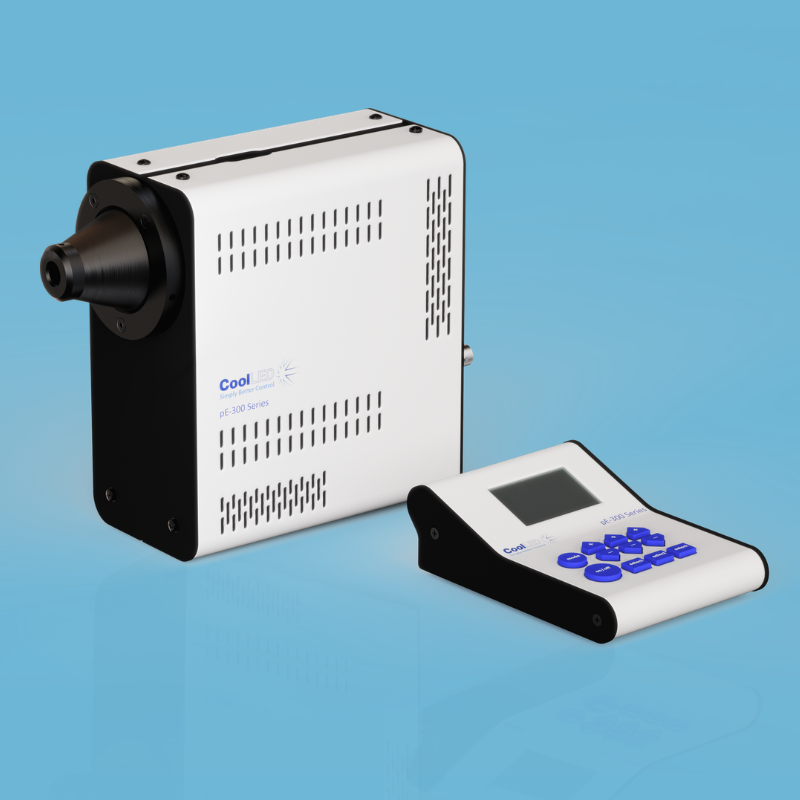
The CoolLED pE-300opto has been developed for optogenetics illumination in neuroscience applications, with 470 nm and 635 nm LED channels, fast TTL control and flexibility for fibre-based or microscopy-based setups.
It's designed for researchers who need practical, controlled LED illumination for optogenetic stimulation, while also supporting fluorescence microscopy applications. That makes it a useful option for labs looking to bring optogenetics into their workflows without adding unnecessary complexity.