NO MORE MERCURY | FROM THE BLOG
Aberdeen, Cardiff, Cambridge... Is Anyone Still Missing Their Mercury Lamps?
There are certain things you get rather attached to in a laboratory. That trusty old microscope you've been using for twenty years. The chair with the one properly adjusted wheel. The piece of equipment that only works if you switch it on in a very particular order and give it a few encouraging words. Mercury lamps, though? We're not convinced they'll inspire quite the same nostalgia.
With the February 2027 mercury lamp phase-out approaching, laboratories across Europe are considering what comes next for their fluorescence illumination. Some have already made the switch, and three UK universities have given us particularly good examples. Aberdeen has completed its transition, Cardiff has secured funding for a wider upgrade, and Cambridge has given an existing microscope a new lease of life.
Aberdeen: The Benefits of Being Organised (We Hear It's Wonderful)
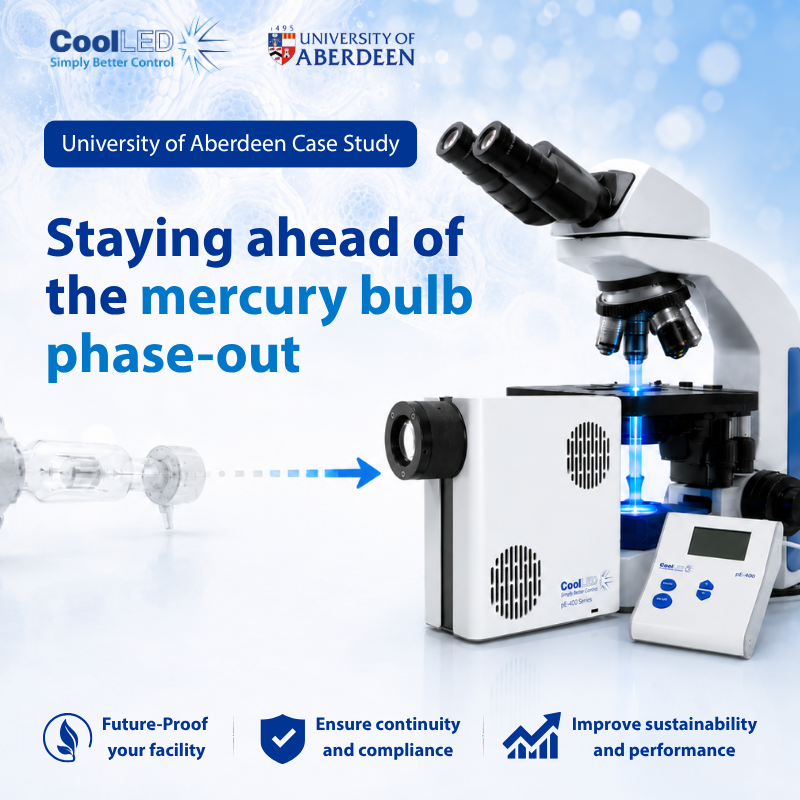
At the University of Aberdeen's Microscopy and Histology Core Facility, Manager Dr Debbie Wilkinson started preparing for the mercury restrictions back in 2022. Rather than stockpiling replacement bulbs and hoping for the best, she worked with CoolLED distributor Scientifica to identify suitable LED replacements for the facility's existing microscopes. By June 2026, two CoolLED pE-300lite systems and a pE-400 had been installed, completing the transition across three microscopes.
The facility now operates without mercury-based fluorescence lamps, with fewer hazardous consumables and no more regular bulb replacements. It's a good example of what happens when someone spots an approaching problem early and actually does something sensible about it. We're told this is an excellent way to manage a laboratory, although we're still working on applying the same principle to our office stationery cupboard.
Cardiff: Generous Funding Goes a Long Way
Meanwhile, Cardiff University's Bioimaging Research Hub has successfully secured £24,000 in Medr funding to replace its entire ageing mercury illumination with a host of CoolLED pE-300white systems. Led by Dr Tony Hayes, the project will see the Hub upgrade its existing widefield epifluorescence equipment, building on its previous experience with CoolLED technology.
Rather than simply taking our word for it (although we're obviously very trustworthy), the team already knew the benefits firsthand. Working with CoolLED partner K-Tec Microscope Services, Cardiff plans to complete the installations before Christmas 2026. The upgrades will bring more stable illumination, lower energy consumption and an end to the inconvenience of mercury lamp replacements. Congratulations to Dr Hayes and the team on securing the funding, and to K-Tec for helping another university move towards more sustainable microscopy.
Cambridge: Don't Replace the Microscope, Replace the Problem
At the University of Cambridge's Department of Physiology, Development and Neuroscience, the problem was rather straightforward. Their Leica DMI6000 microscope was still doing a perfectly good job, but replacement bulbs for its ageing metal halide illumination were becoming harder to find. Working with UK microscopy specialist GT Vision, the department upgraded to a CoolLED pE-300white, extending the microscope's working life and providing reliable illumination for genetics research, including fluorescent sample screening ahead of confocal imaging.
Strictly speaking, this wasn't originally a No More Mercury project, as the upgrade happened earlier in 2026. But it's a great example of the same principle. Why replace an otherwise useful microscope when updating its illumination can solve the problem? Thanks to GT Vision for sharing the story and helping Cambridge keep its existing equipment working for longer.


Three Universities, One Less Thing to Worry About
Different universities, different circumstances, but a similar outcome. Aberdeen planned ahead, Cardiff secured funding, and Cambridge wanted to keep a good microscope running. All three show that moving away from traditional illumination doesn't have to mean replacing perfectly serviceable equipment.
With relevant EU RoHS exemptions for mercury-containing lamps expiring on 24 February 2027, now's a sensible time to consider the options. LEDs offer instant operation, stable illumination, fewer consumables and substantially lower energy consumption. Independent testing by Green Light Laboratories found that the CoolLED pE-300lite consumed 93% less energy than the metal halide system tested, so there are potential savings alongside the environmental benefits.
And if anyone at Aberdeen, Cardiff or Cambridge genuinely misses waiting for a lamp to warm up or discovering their last replacement bulb has blown, we'd be fascinated to hear about it. Somehow, we suspect we won't.
Still Using Mercury or Metal Halide Illumination?
Whether you're upgrading one microscope or planning a facility-wide transition, CoolLED and our microscopy partners can help you find a suitable LED replacement for your existing equipment.
Find Out How We Can Help →