


Overview
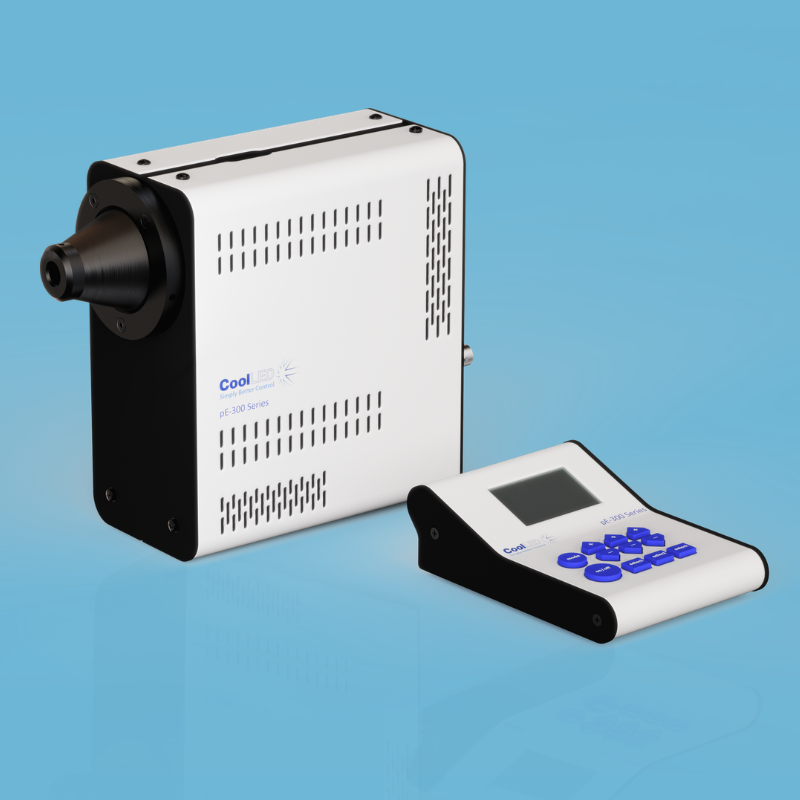
The CoolLED pE-300opto is a highly controllable Illumination System built for scientists using optogenetics.
High-speed illumination delivers precision stimulation for a wide range of opsins in both ex vivo or in vivo experiments – and also supports fluorescence imaging for maximum flexibility.
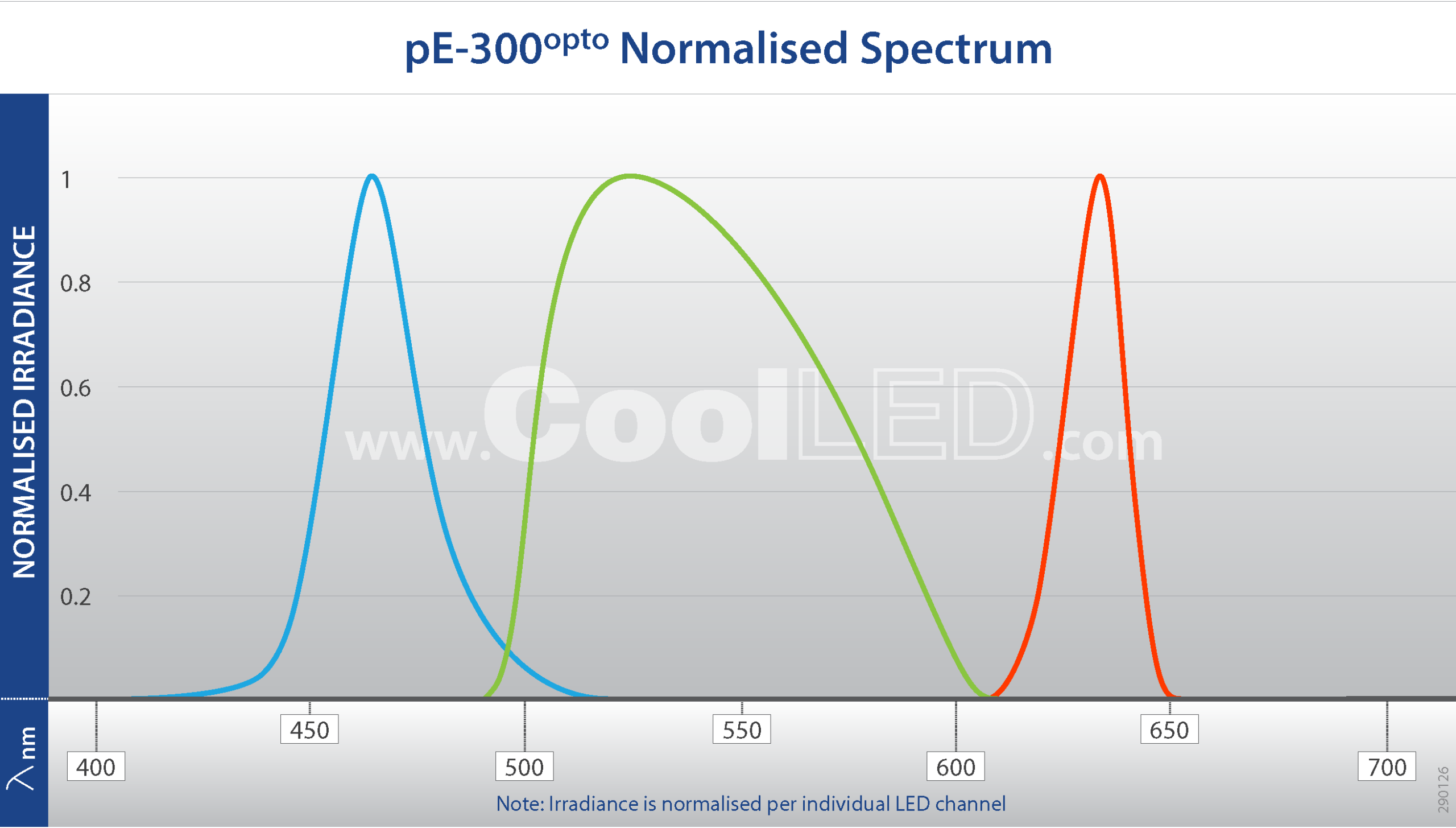
The pE-300opto combines comprehensive opsin compatibility, fast channel triggering and easy switching between liquid light guide and fibre, for optogenetic stimulation and imaging with accuracy and reliability.
Freedom to use a range of opsins
Three powerful LEDs – blue (470 nm), green-yellow (550 nm) and red (635 nm) – each can be optimised with inline excitation filters to match the most widely used opsins, including:
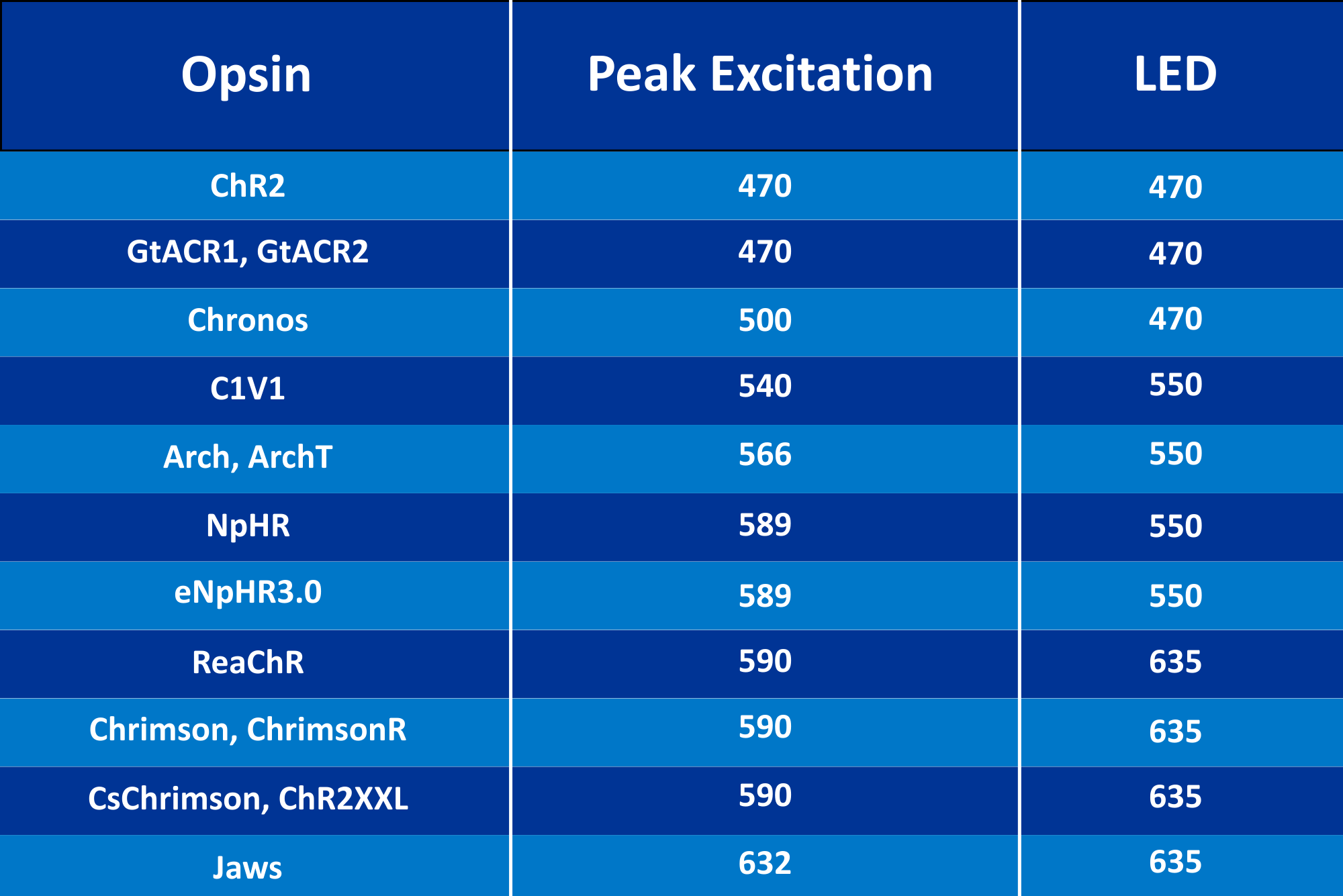
With the growing adoption of red-shifted opsins such as ChrimsonR, the pE-300opto is designed with future-proofing in mind, enabling researchers to explore new opsins as they emerge.
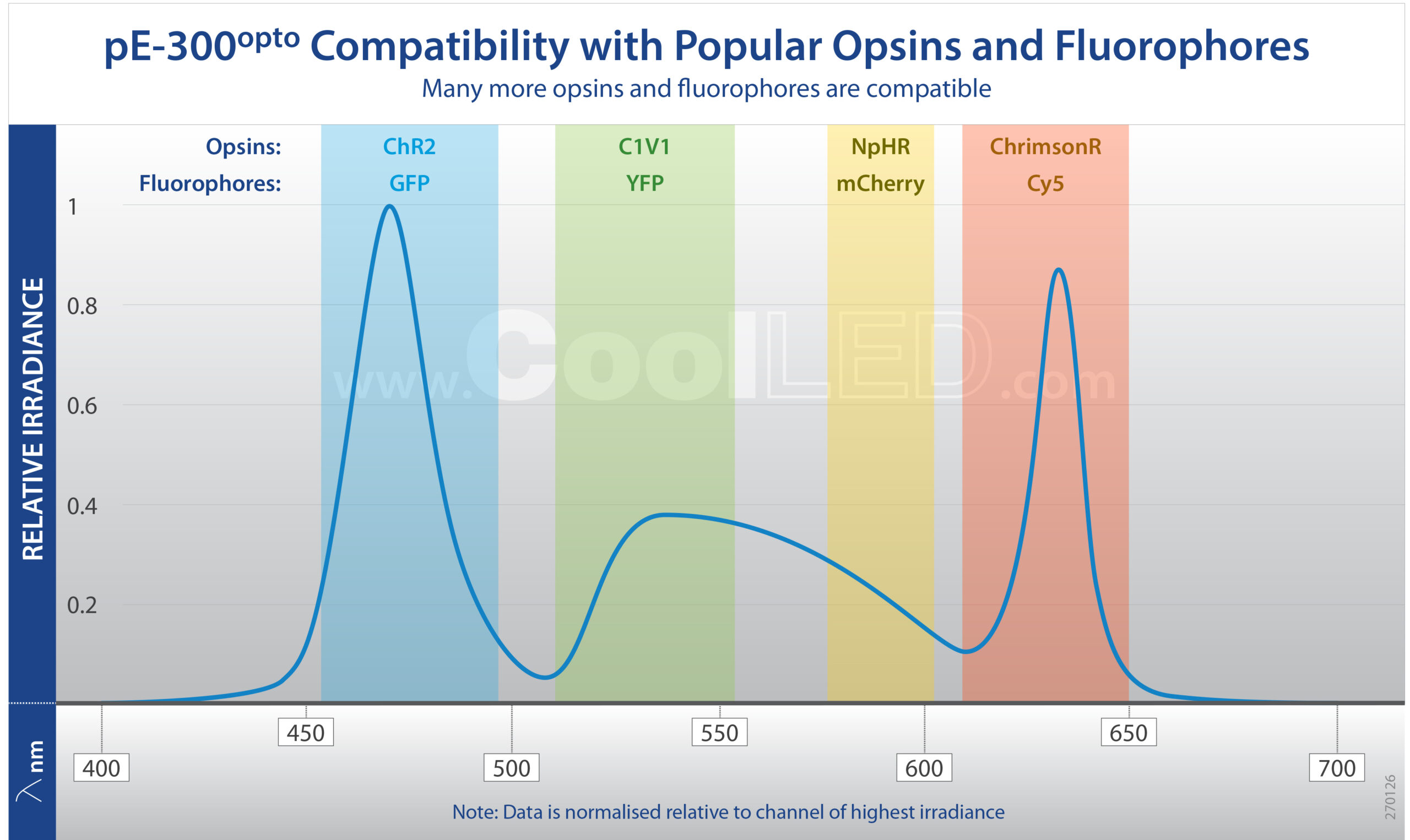
In addition to optogenetics, the system supports fluorescence imaging with commonly used fluorophores including GFP, YFP, mCherry and Cy5, making it ideal for visualising fluorescently labelled constructs or combined stimulation and imaging experiments.
Run fast, dynamic stimulation sequences
Dynamic, high-speed multi-opsin stimulation is at the heart of the pE-300opto. Each LED can be individually controlled via <10 µs TTL triggering, while inline filters can enable clean spectral separation for multi-opsin protocols. The irradiance of each channel can also be modulated to fine-tune stimulation levels when working with multiple opsins.
For simplified high-speed operation, the Sequence Runner program combines the simplicity of manual control and high-speed TTL. Once an LED and irradiance sequence are specified using the manual control pod, the sequence cycles through automatically – with triggering synchronised via the global TTL input of the pE-300opto and a single TTL output from a camera. This makes it easy to implement high-speed stimulation without the need for additional control hardware.
Switch between ex vivo, in vivo optogenetics and imaging
A liquid light guide output comes as standard, which is ideal for ex vivo optogenetics under the microscope, as well as fluorescence imaging from GFP through YFP to Cy5.
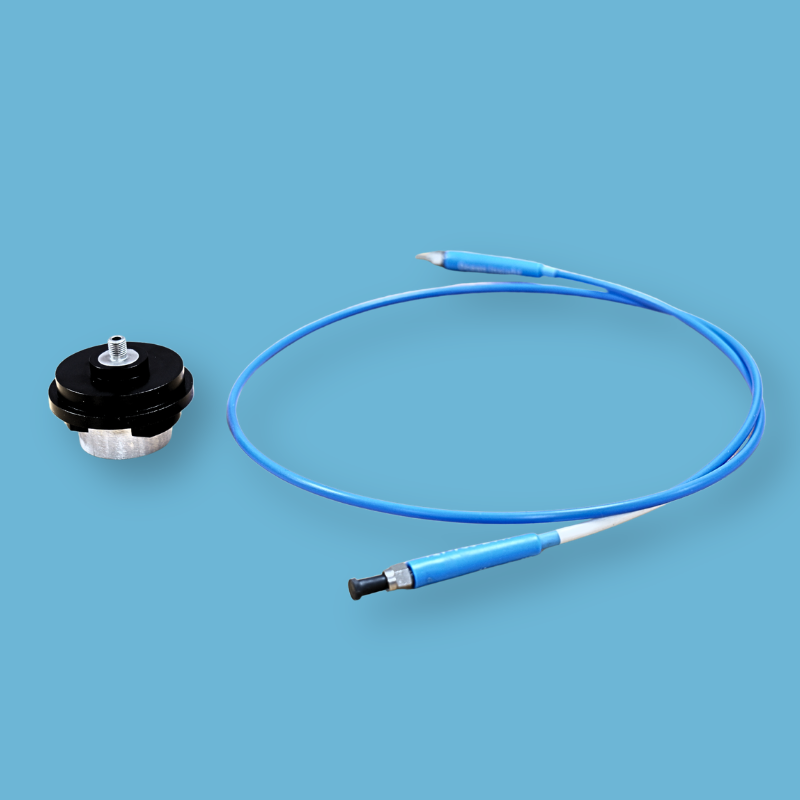
For in vivo experiments, an optional adaptor allows a fibre output (either SMA or FC), and the output can be easily swapped in the field. This versatility allows neuroscience researchers to use the same light source across multiple experimental setups – from in vivo fibre stimulation to ex vivo slice work and imaging.
The pE-300opto offers:-
- 3 channels that can be individually controlled, with any simultaneously running at 100%
- Broad spectrum compatibility from Chr2 to ChrimsonR
- Inline excitation filter holders included: no moving parts for high-speed triggering
- Optional output adaptor for fibre (SMA or FC) to enable in vivo optogenetics
- <10 µs global and channel TTL triggering for high-speed imaging
- Optimised irradiance control in 1% steps (0-100%)
- Sequence Runner for running complex high-speed stimulation protocols
- Simple control pod for intuitive manual operation
- Seamless integration into compatible third-party imaging software
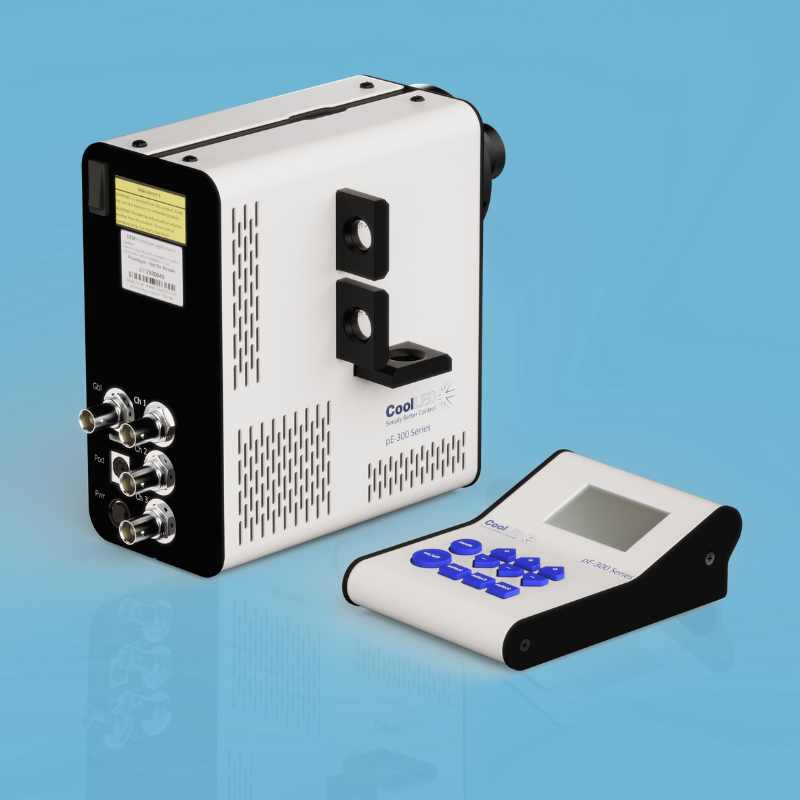
The system comprises a pE-300opto Light Source, Control Pod, set of three Excitation Filter Holders, and Power Supply.
Control
Control pod for operation and access to settings and usage history.
Manual:
Manual control for instant on/off and irradiance control in 1% steps from 0 – 100%
Individual bands can be selected/deselected and controlled independently as desired
Remote:
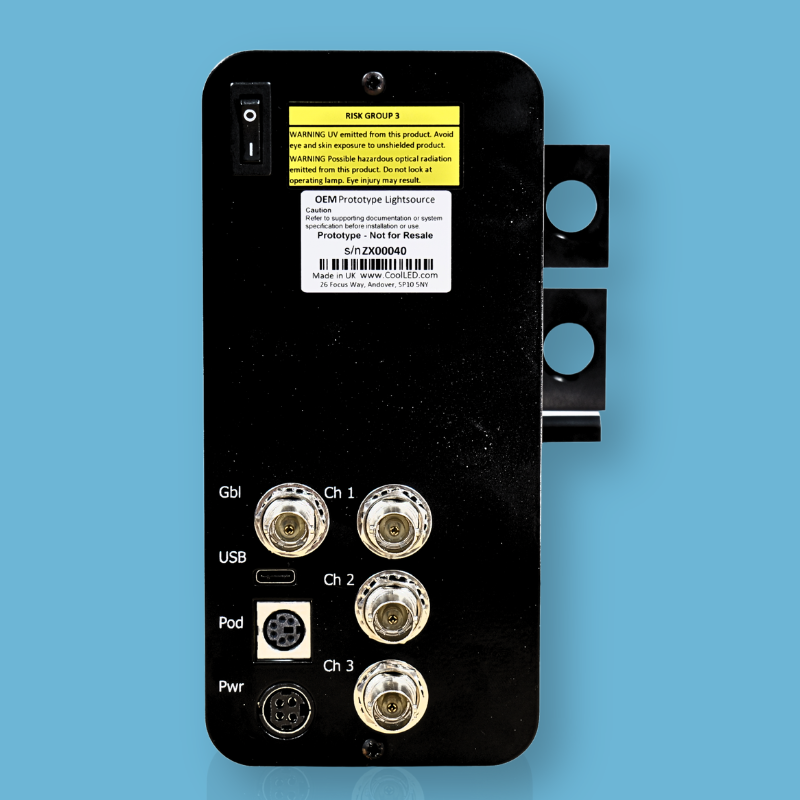
Via global and individual channel TTL for on/off control of selected channels using a BNC connection on the Light Source.
Triggering speed <10 µs at full power
Connectivity:
Remote via USB (C type) for imaging software control (see Imaging Software)
Sequence Runner:
Single TTL input to step through user defined sequence.
Triggering speed <10 µs at full power
Specification
Power requirements
100-240 V a.c. 50/60 Hz
Power consumption
| pE-300opto | At the wall (includes power supply unit consumption) | |
| Standby | 2.3 W | |
| 1 band (GYR) | 23 W | |
| 2 bands (BLU & GYR) | 31 W | |
| Full white irradiance (3 bands) | 38 W |
Dimensions
pE-300opto Light Source (LLG): 77 mm(w) x 187 mm(d) x 162 mm(h) – Weight 1.59 kg
pE-300opto Light Source (Fibre): 77 mm(w) x 160 mm(d) x 162 mm(h) – Weight 1.59 kg
pE-300opto Control Pod: 88 mm(w) x 125 mm(d) x 37 mm(h) – Weight 0.32 kg
pE-300opto Power Supply: 167 mm(w) x 67 m(d) x 35 mm(h) – Weight 0.62 kg
pE-Universal Collimator: 44 mm(w) x 86 mm(d) x 44 mm(h) – Weight 0.17 kg
Environment and Safety
LED products are more sustainable and energy efficient than conventional illuminators. CoolLED’s products have the following benefits:
- Mercury-free and laser-free
- Energy Efficient
- Long lifetime
- No bulb replacements
- Reduced risk of eye damage
- Quiet operation
- No special disposal regulations or issues
Warranty
Industry-leading 36 months. Read more here.
All data correct at time of publication
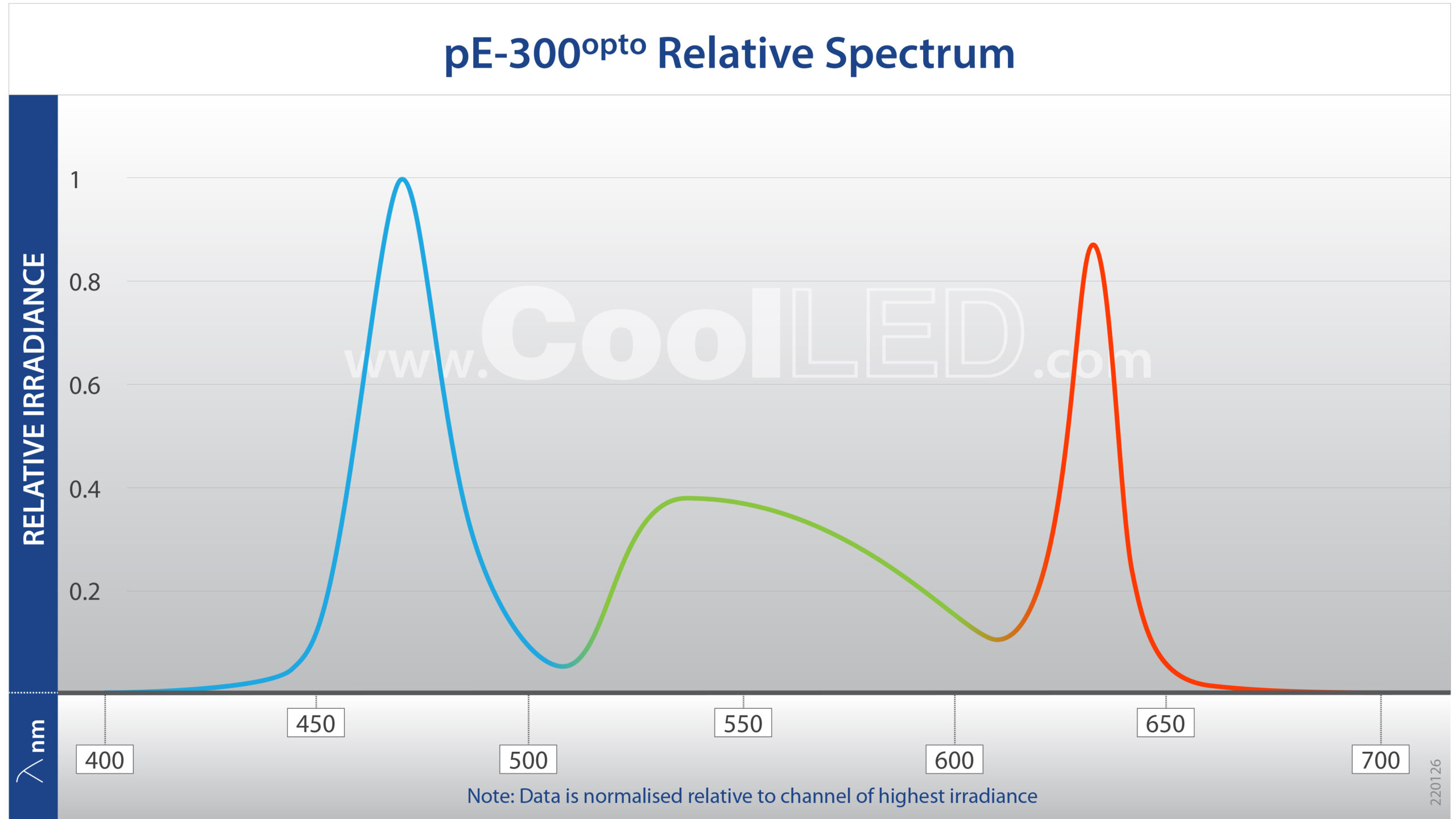
We are often asked about the power, intensity or irradiance of CoolLED Illumination Systems. The answer is not as simple as you might believe from many websites and data sheets, and it can be difficult to compare data from these sources as measuring set ups differ.
Photons are also lost as light travels from the light source to sample plane. The only way to objectively compare light sources is by measuring irradiance at the sample plane. To understand why we use the term irradiance and how to measure and compare light sources with accuracy and precision, download our white paper. Or please contact us if you have further questions.
For performance data, please contact us
The scientific community is driving change across academia, industry and government to make laboratories more sustainable. When it comes to fluorescence microscopy illumination, switching to the pE-300opto can help laboratories meet their sustainability targets, by consuming less energy and avoiding the use of toxic mercury.
Visit our environment page to find out more.
“It’s great to see how My Green Labs and CoolLED are helping to move things ahead in the area of laboratory sustainability”. – Todd Lynch, UCLA Capital Programs
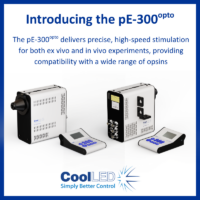
Introducing the pE-300opto
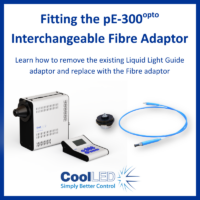
pE-300opto – How to fit the interchangeable fibre adaptor
The pE-300opto wavelengths are designed to work with the following excitation filters:
| Specification |
| 475/40 |
| 535/40 |
| 590/25 |
| 630/40 |
| pE-300-OPTO-L-ZZ: | pE-300opto Illumination System for use with 3 mm liquid light guide. Includes Light Source, Control Pod, Power Supply, three Excitation Filter Holders, cradle & power cable (ZZ) |
| pE-1906: | 1.5 m long, 3 mm diameter liquid light guide |
| pE-10400-YYY: | Universal collimator for use with a single liquid light guide, and customer specified microscope adaptor |
| pE-300-OPTO-F-MODULE: | Interchangeable fibre adaptor |
To specify microscope code (YYY) see Adaptors
To specify power cable (ZZ): 10 = Australia, 20 = Europe, 30 = UK, 40 = USA
More information is available on the Accessories tab.
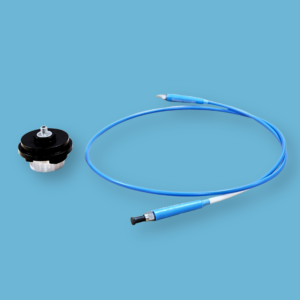
pE-300opto Interchangeable fibre adaptor
The CoolLED pE Driver is sometimes required for software integration - find out more and download the driver here.
Contact CoolLED for further information.
The award winning pE-300 Series is a range of LED Illumination Systems for Fluorescence, Optogenetics, Electrophysiology and high speed microscopy applications. It comprises 3 systems providing a solution that covers a range of everyday fluorescence microscopy; from the simple pE-300lite through the classic pE-300white to the highly controllable pE-300ultra.
The pE-300opto also provides a specialised solution for optogenetics.
The table below is a quick reference guide to the features offered by the pE-300 Series systems.
| Features | pE-300lite | pE-300white | pE-300ultra | pE-300opto |
|---|---|---|---|---|
| Broad spectrum | ||||
| Simple to fit and use | ||||
| Instant on/off | ||||
| No bulb replacement | ||||
| Direct or Light Guide delivery options | ||||
| Long lifetime | ||||
| Stable & Repeatable - 10-100% intensity control | ||||
| Filter set compatibility | ||||
| Mercury free | ||||
| Individual channel intensity control | ||||
| Individual channel selection | ||||
| Integration with imaging software | ||||
| Global remote triggering (TTL, microsecond) | ||||
| Individual channel triggering (TTL, microsecond) | ||||
| Removable inline filter holders | ||||
| Sequence Runner | ||||
| Optional Interchangeable Fibre Adaptor | ||||
| LEDs optimised for Optogenetics |
