They might not have the most wavelengths or the longest list of features, but CoolLED's pE-300 Series has been quietly getting on with the job for years. And with laboratories increasingly moving away from mercury lamps, these familiar favourites have never been more relevant.
At CoolLED, we're always looking ahead. More wavelengths, faster switching and increasingly advanced illumination systems continue to expand what's possible in fluorescence microscopy.
Products like the pE-800, pE-400 Series and pE-10 naturally attract attention for their capabilities in demanding research applications. But while these systems take the spotlight, there's another range that deserves some recognition.
Meet the pE-300 Series. Our best-selling workhorses, and proof that sometimes, keeping things simple is exactly what a laboratory needs.
Covering routine fluorescence observation, multi-colour imaging and fast, synchronised illumination, the pE-300lite, pE-300white and pE-300ultra offer three different levels of control, all with the benefits of mercury-free LED technology.
Three systems. Three approaches to fluorescence microscopy.
Not every laboratory needs eight wavelengths, advanced sequencing or extensive automation. For many, the priority is consistent fluorescence illumination that's easy to operate and compatible with existing microscopes. The pE-300 Series covers these requirements, with additional control available when needed.
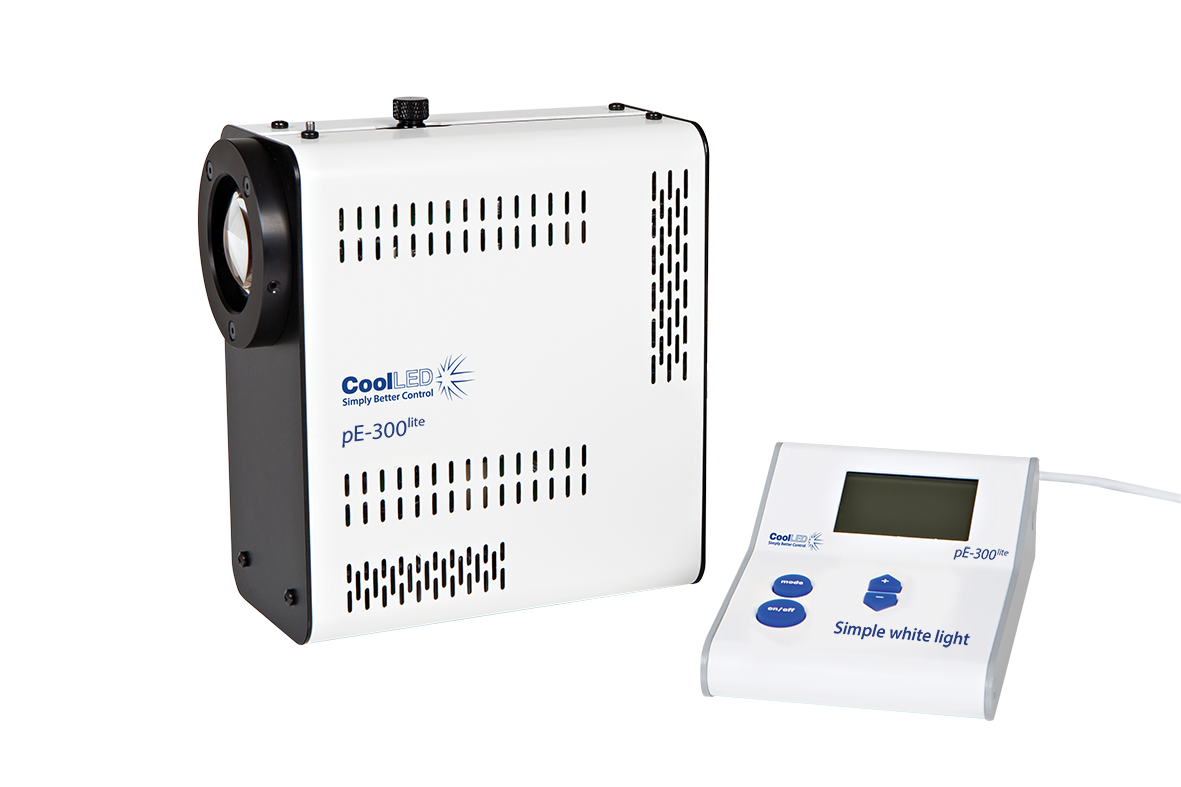
pE-300lite
Straightforward fluorescence, without the fuss.
Sometimes, all you need is a light source that turns on, illuminates your sample and lets you get on with your work. That's the idea behind the pE-300lite.
It provides broad-spectrum LED illumination for common fluorophores, from DAPI through to Cy5, with simple manual on/off and overall intensity control. There's no warm-up period, bulb alignment or complicated setup.
Ideal for routine fluorescence microscopy, teaching facilities and hospital laboratories, it's a straightforward mercury or metal halide replacement for users who don't need individual wavelength control.
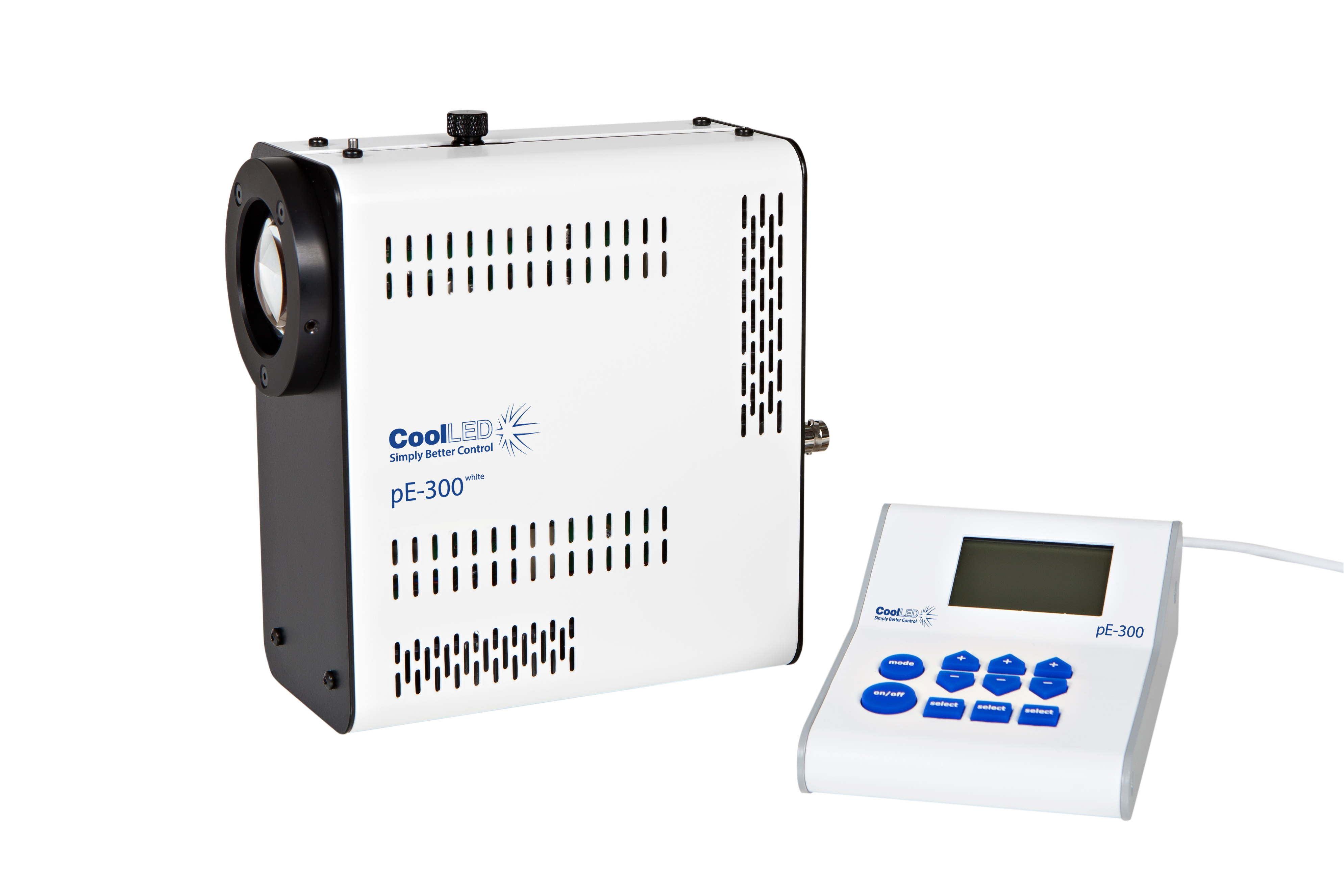
pE-300white
More control for everyday multi-colour fluorescence.
For laboratories working with several fluorescent stains, the pE-300white introduces more flexibility without making operation complicated.
Its three LED wavebands can be controlled independently, allowing users to balance excitation across different fluorophores. With suitable multi-band filters, individual stains can be viewed separately or in combination without changing filter cubes.
With USB software control and global TTL triggering, it's well suited to immunofluorescence, multi-colour imaging and automated laboratory workflows.
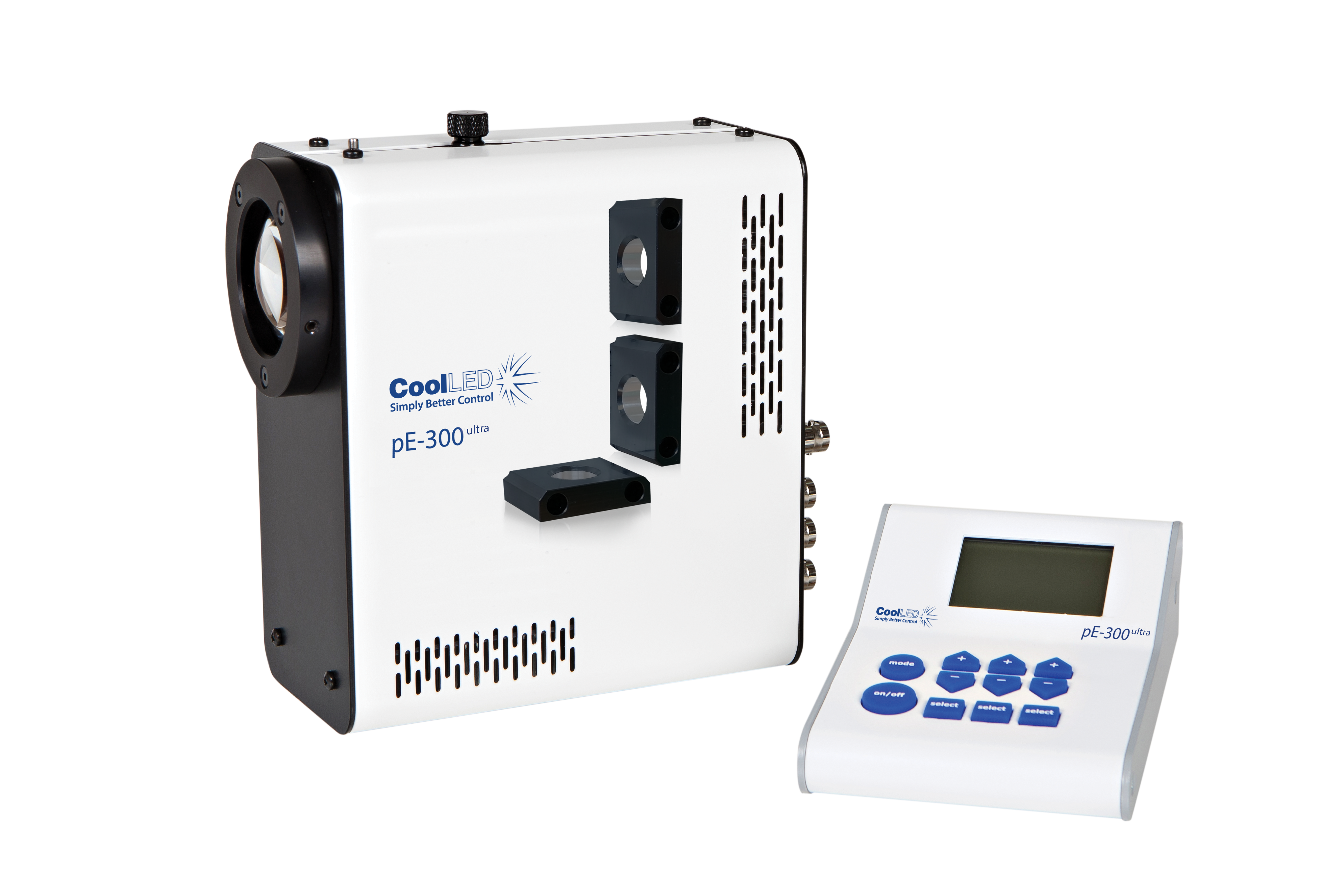
pE-300ultra
When timing and individual channel control matter.
The most controllable of the three systems, the pE-300ultra adds features for more demanding fluorescence microscopy.
Independent channel triggering, removable inline excitation filters and CoolLED's Sequence Runner functionality give researchers precise control over illumination. Microsecond switching allows LEDs to be synchronised with cameras and other equipment.
For live-cell experiments, fast multi-channel acquisition and time-sensitive imaging, it offers greater control without necessarily requiring a larger illumination system.
Which pE-300 system is right for your microscope?
The main difference is the level of illumination control. All three provide broad-spectrum, mercury-free LED illumination, but each suits different applications and workflows.
| Feature | pE-300lite | pE-300white | pE-300ultra |
|---|---|---|---|
| Primary use | Routine fluorescence | Multi-colour imaging | Fast, controlled imaging |
| Intensity control | Overall output | Individual LED bands | Individual LED bands |
| USB control | No | Yes | Yes |
| TTL triggering | No | Global | Individual channels |
| Sequence Runner | No | No | Yes |
| Mercury-free | Yes | Yes | Yes |
The wider pE-300 Series also includes the pE-300opto, designed for optogenetics. View the complete range.
A familiar solution to an increasingly urgent problem
For decades, mercury and metal halide lamps have been standard equipment in fluorescence microscopy. But replacement bulbs, warm-up periods, declining lamp performance and ongoing maintenance have always been part of the experience.
Now, the future of mercury-based illumination is changing. Relevant EU RoHS exemptions for mercury-containing lamps are due to expire on 24 February 2027. Existing microscopes won't suddenly become illegal to use, but sourcing replacement lamps could become increasingly difficult.
Fortunately, moving to LED doesn't necessarily mean replacing the microscope. All three pE-300 systems offer mercury-free illumination with Direct Fit or liquid light guide options for a wide range of existing microscope setups.
With instant on/off operation, stable intensity control and no routine bulb replacement, the pE-300 Series provides a practical alternative to mercury and metal halide lighting.
Lower energy use, lower running costs
Independent testing by Green Light Laboratories at the University of Bristol compared conventional metal halide illumination with modern CoolLED technology. The results showed substantial reductions in energy consumption and projected running costs for the pE-300lite.
Figures relate to the specific equipment tested by Green Light Laboratories. Actual savings depend on usage, electricity costs and equipment configuration.
Discover No More Mercury →Common questions about the pE-300 Series
Looking for a quick answer? Select a question below for more information.
What's the difference between pE-300lite, white and ultra?
The pE-300lite offers simple overall intensity control. The pE-300white adds independent control of three LED bands, USB and global TTL triggering. The pE-300ultra adds individual channel triggering, inline excitation filtering and Sequence Runner.
Can a pE-300 replace a mercury or metal halide microscope lamp?
Yes. The pE-300 Series offers mercury-free LED illumination with Direct Fit and liquid light guide configurations. Microscope compatibility and optical filters should be checked before choosing a system.
Can I keep my existing fluorescence filter sets?
Often, yes. Different pE-300 configurations accommodate single-band and multi-band optical filter arrangements. CoolLED can help confirm compatibility with your microscope and fluorophores.
Which pE-300 is best for routine fluorescence microscopy?
For simple manual observation, the pE-300lite is generally the most straightforward option. Choose the pE-300white when independent wavelength control is needed, or the pE-300ultra for fast, precisely synchronised imaging.
Sometimes, simple is exactly what you need.
It's easy to associate progress in microscopy with more wavelengths, greater automation and increasingly advanced equipment. For some applications, those developments are essential.
But across countless laboratories, the everyday requirements remain much the same: illuminate the sample, capture a clear image and obtain consistent results. That's where the pE-300 Series continues to earn its place.
From the uncomplicated pE-300lite to the controllable pE-300white and fast-switching pE-300ultra, each provides a different level of functionality built around the same straightforward approach to fluorescence microscopy.
They might not always be the first products we talk about, but they're among the ones our customers continue to choose. And we think it's about time they received a little more attention.
Find the right pE-300 for your microscope
Whether you're replacing an ageing mercury lamp, upgrading an existing fluorescence microscope or choosing illumination for a new laboratory, we're here to help.
Tell us about your microscope, filters and applications, and we'll help you find the right LED system.
Explore the pE-300 Series Contact CoolLED