
What is optogenetics?
Optogenetics is a technique where scientists add light-sensitive proteins to cells so they can switch those cells on or off simply by shining the right colour of light.
If the right wavelength hits the protein, the cell responds. Change the colour or intensity, and the response changes too.
It’s a clever way to study how neurons fire, how heart cells behave, or how gene circuits activate, all with much more control than chemicals or electrical stimulation.
But there’s a catch: optogenetics only works well if the light itself is accurate, stable and delivered at exactly the wavelength the protein responds to. If the illumination drifts, or the colour is off, or the timing isn’t precise, the experiment won’t behave the way you expect.
That’s why choosing the right light source is such a big deal.
Why the illumination really matters
Every optogenetic tool responds to a specific, narrow slice of the spectrum.
For example:
-
ChR2 likes blue light around 470 nm
-
Halorhodopsin responds to yellow-green light
-
Chrimson needs deep red
-
Some photoactivatable proteins require near-UV
So using a broad, drifting or slow light source can make activation unreliable.
What researchers actually need is:
-
a defined wavelength, not a vague “blue-ish” output
-
stable brightness, so each pulse is identical
-
fast switching, especially for timed pulses
-
low heat, to avoid warming samples
This is where LEDs excel, especially when they’re purpose-built for activation rather than imaging.
Meet the pE-300opto
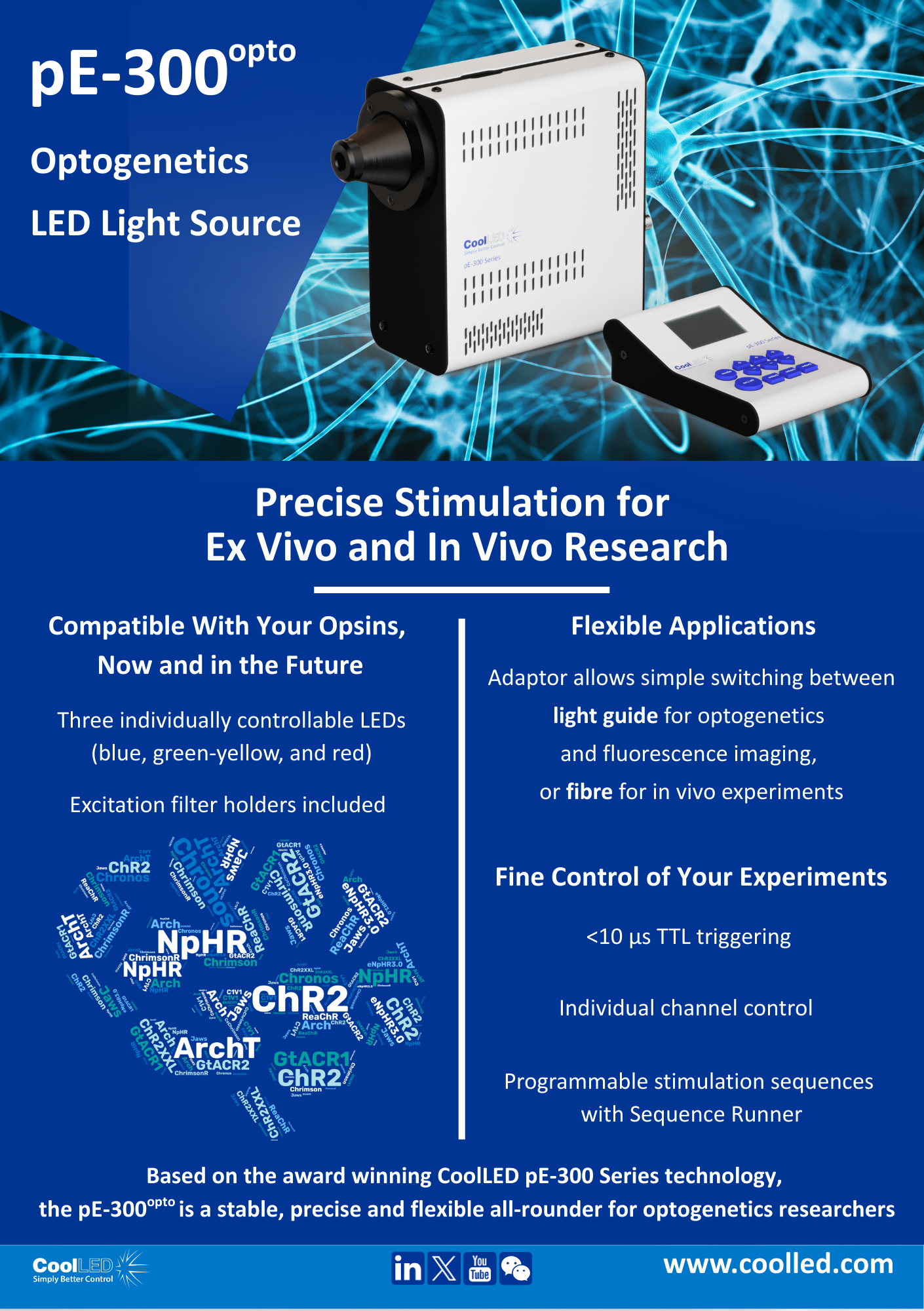
Featuring three individually controllable LEDs (blue at 470 nm, green-yellow at 550 nm, and red at 635 nm), the pE-300opto covers the most popular opsins from ChR2 through to ChrimsonR.
A liquid light guide output comes as standard, ideal for ex vivo optogenetics under the microscope, as well as fluorescence imaging from GFP through YFP to Cy5. For in vivo experiments, an optional adaptor allows quick switching between the liquid light guide and SMA or FC fibres, offering unmatched flexibility.
These cover many of the most commonly used optogenetic tools, giving researchers the right colour without complexity.
Other features include:
-
2–100% linear intensity control (ideal for dose-dependent activation)
-
fast digital triggering for accurate timing
-
very low heat at the sample
-
lightweight, easy mounting on standard microscope ports
-
no warm-up, no alignment, no bulb changes
It’s familiar if you’ve used the pE-300 family before, but tuned specifically for optogenetic workflows.
Why optogenetics and the pE-300opto fit together
Optogenetics is all about precise control: the right wavelength, the right intensity, the right timing.
The pE-300opto is built to deliver exactly that, not as a general imaging light, but as a stable, predictable light source.If your experiment relies on pulsing neurons, triggering photoactivatable proteins or driving synthetic biology pathways with light, the pE-300opto gives you the confidence that the light input is consistent every time.
It’s a straightforward, reliable way for labs to run optogenetics without needing a complicated fluorescence microscopy light source; offering just the wavelengths and control that matter, in a compact, affordable package.
Written by Ben Furness / [email protected] / LinkedIn Profile