
Real-world LED vs Metal Halide Performance for Fluorescence Microscopy
CoolLED has launched a new set of illumination performance comparison graphs that measure and compare LED and metal halide illumination based on irradiance at the sample plane of the microscope. The graphs show real-world illumination performance across common fluorescence channels. This allows microscopists and imaging facilities to make direct, practical comparisons when selecting or replacing illumination systems.
Understanding illumination performance is essential when selecting an illumination system for fluorescence microscopy. However, absolute power values alone rarely reflect how a light source performs in real imaging conditions. To address this, CoolLED has developed a new series of comparison graphs that benchmark LED illumination systems directly against metal halide lamps using irradiance measured at the sample plane.
Power Performance Graphs
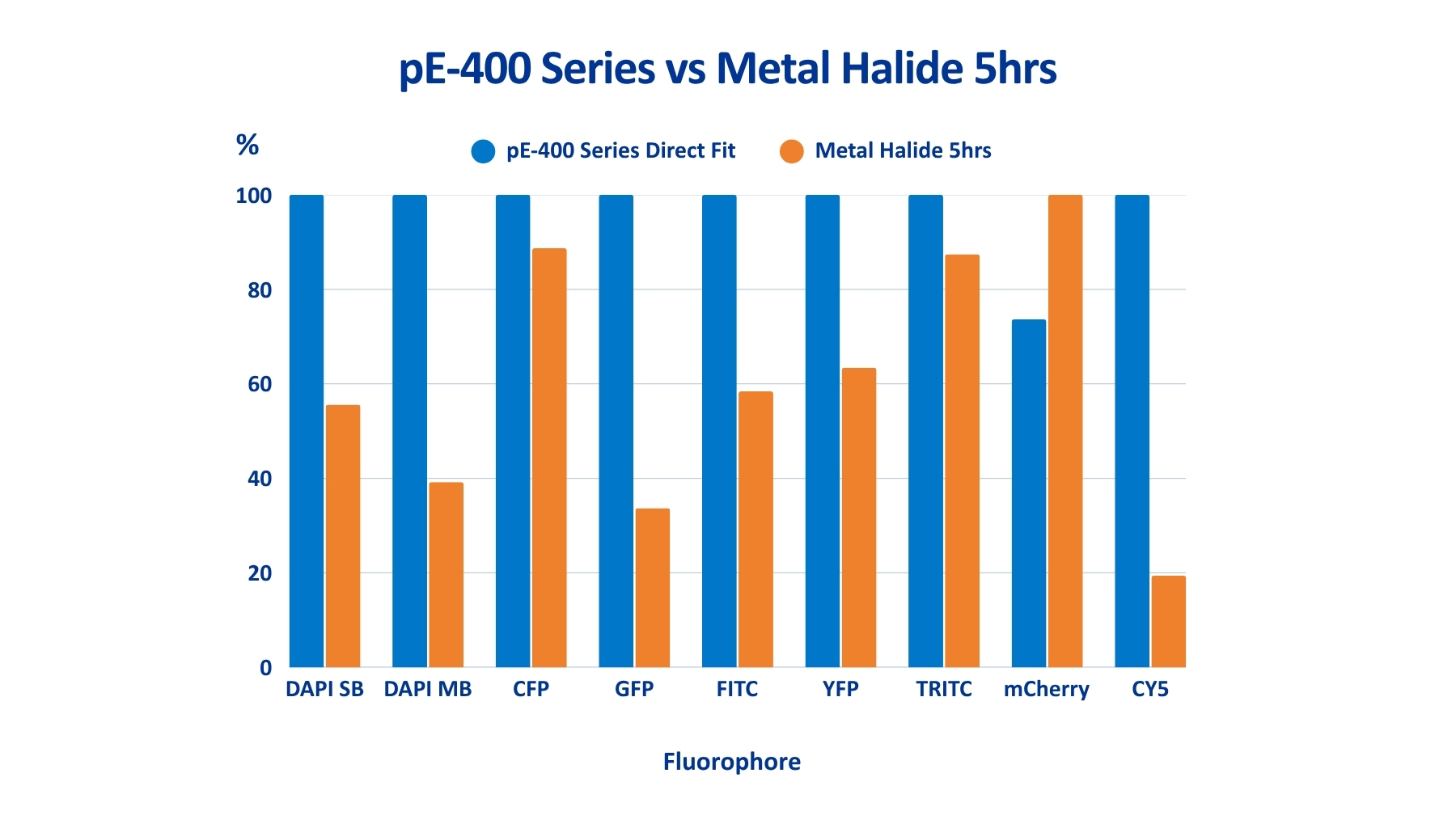
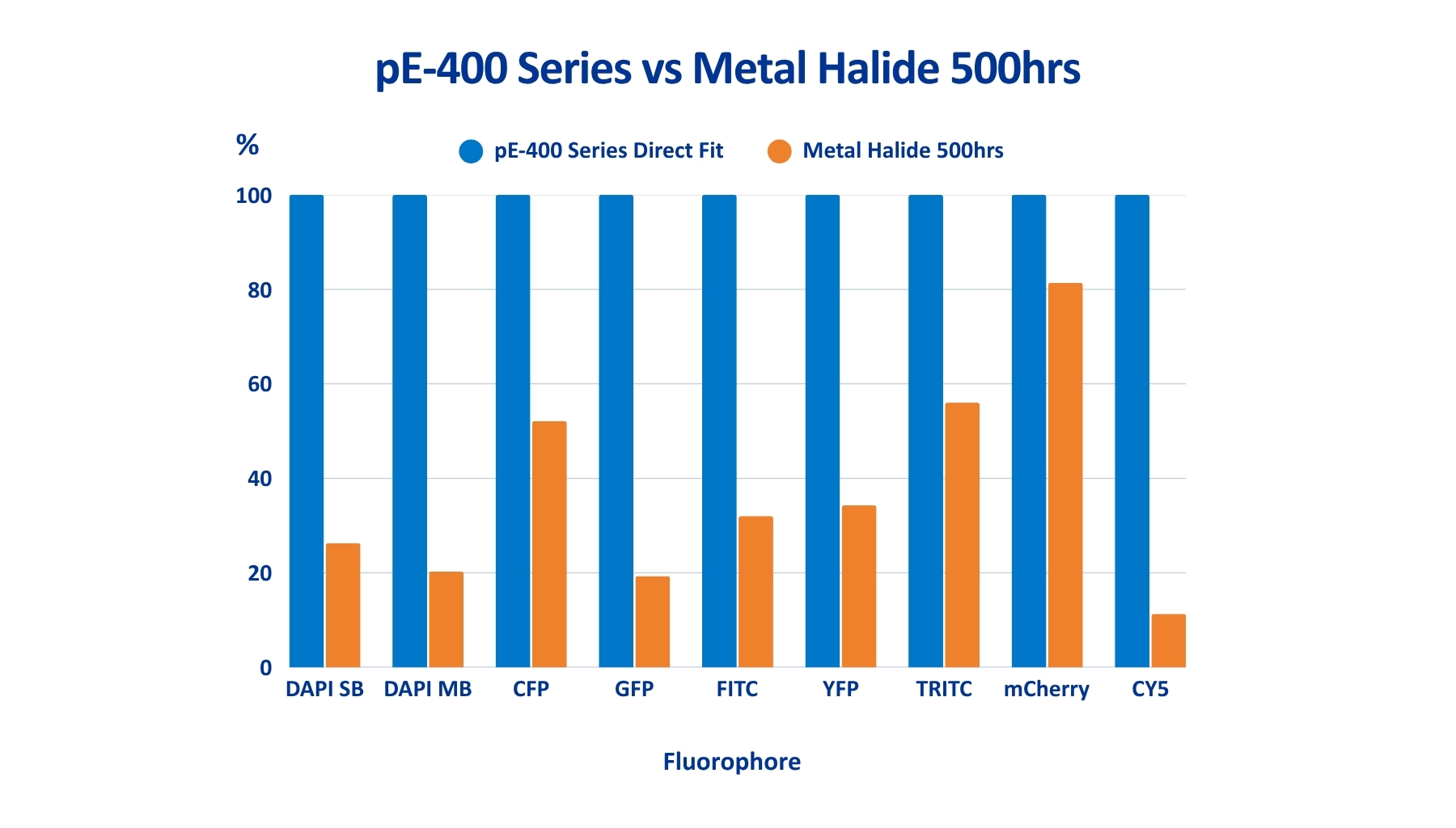
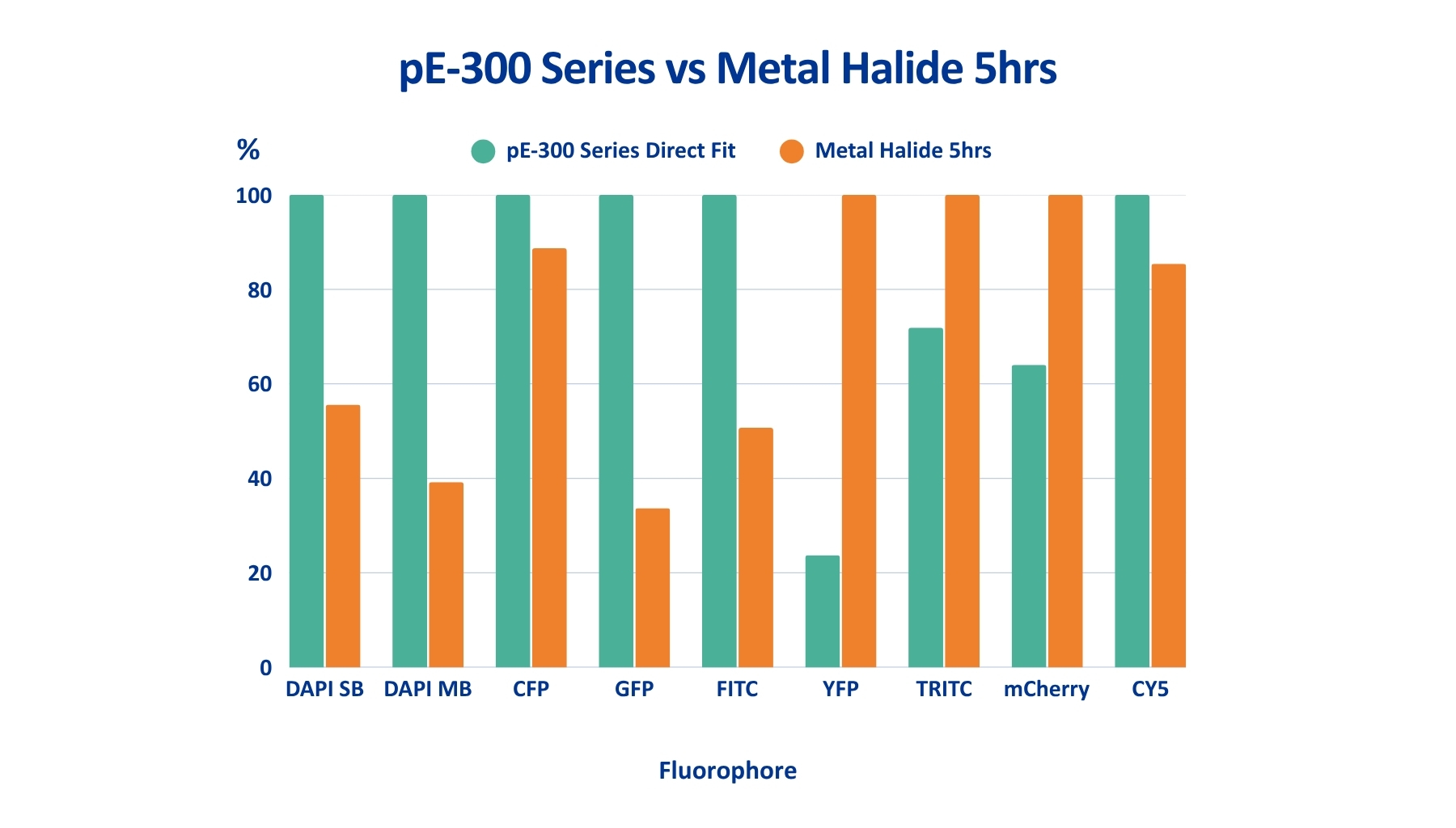
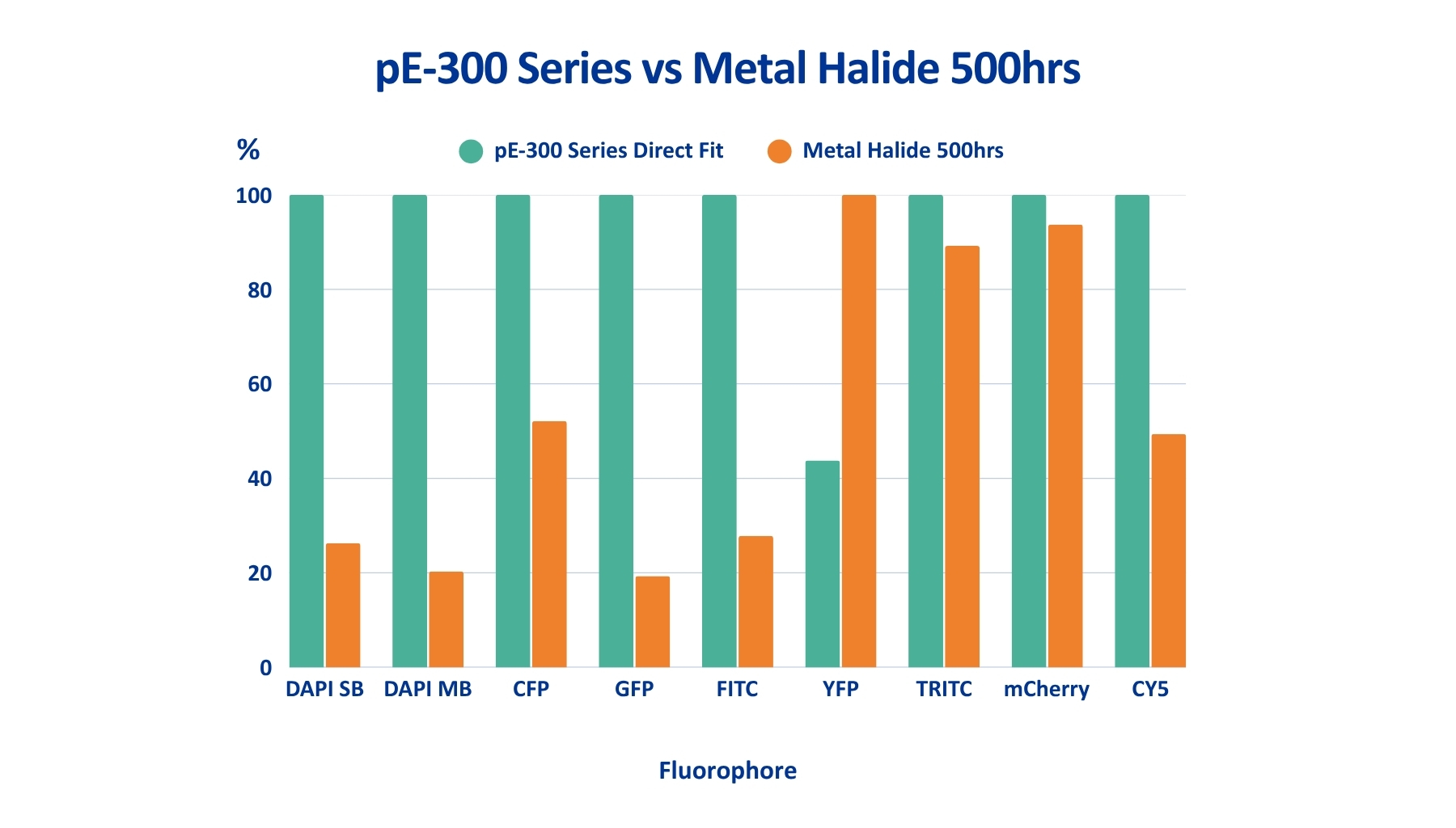
Absolute irradiance measured under identical conditions (standard inverted microscope, 40× objective) and independently normalised within each filter band, with values expressed relative to the brighter light source (100%). Data are representative of CoolLED illumination systems and may vary between individual units.
Filter specifications: DAPI SB: 375/28x / DAPI MB: 395/25x / CFP: 436/20x / GFP: 470/40x / FITC: 480/40x / YFP: 500/20x / TRITC: 540/40x / mCherry: 565/55x / Cy5: 640/30x




LED Illumination vs Metal Halide
The graphs present irradiance data through standard excitation filters for commonly used fluorophores, allowing users to compare brightness in a context that is immediately familiar. Because metal halide lamps have historically been the reference standard for fluorescence illumination, using them as a baseline provides an intuitive and practical way to evaluate LED system performance.
Stable LED Illumination for Microscopy
In addition to single-point performance, the new graphs also show how metal halide lamp output degrades between 5 and 500 hours of use, compared with the inherently stable output of LED illumination systems. This highlights one of the key advantages of LED technology: consistent, repeatable illumination without warm-up times, bulb ageing effects, or unpredictable intensity drift.
Microscope Illumination Comparison
These comparison graphs are designed to support informed decision-making for anyone transitioning from lamp-based illumination to LED systems, or evaluating different LED solutions for their microscopy workflows. By visualising relative performance across common fluorescence channels, the data reflects how illumination behaves in real experimental conditions rather than theoretical specifications.
The new performance graphs are now available on individual CoolLED product pages and are being rolled out across CoolLED product literature and application materials. For further information or to discuss specific system requirements, please contact [email protected]