
LED Illumination for Optical Semiconductor Inspection & Metrology
Semiconductor manufacturing continues to evolve toward greater device complexity, increasing the pressure on optical inspection and metrology systems. Throughput and yield targets demand tighter process control at every stage of the fabrication workflow, from bare-wafer surface inspection to advanced packaging verification.
This is where the quality of illumination within an optical tool comes in, which is a primary determinant of inspection performance.
LED illumination is now the technology of choice for optical semiconductor inspection and metrology, offering high stability, long lifetimes and spectral flexibility over traditional lampbased sources. As device complexity grows and inspection requirements become ever more demanding, even existing LED solutions can struggle — differences in optical architecture, drive electronics, thermal management and wavelength selection directly impact measurement capability.
Find Out
- Why illumination quality determines yield
- LED advantages over lamp and laser sources
- Key specifications for LED illumination systems
- Introducing the CoolLED Amora OEM platform
1. Limitations of Conventional Light Sources
Halogen, xenon, mercury, and laser-induced plasma sources each carry well-understood constraints that increasingly conflict with the demands of modern semiconductor inspection tools:
2. Technical Advantages of LED Illumination
2.1 Spectral Precision and Wavelength Selectivity
LEDs enable precise selection of the wavelength, or combination of wavelengths, that is most informative for a given inspection task. Different wavelengths interact with semiconductor materials and structures in distinct and exploitable ways:
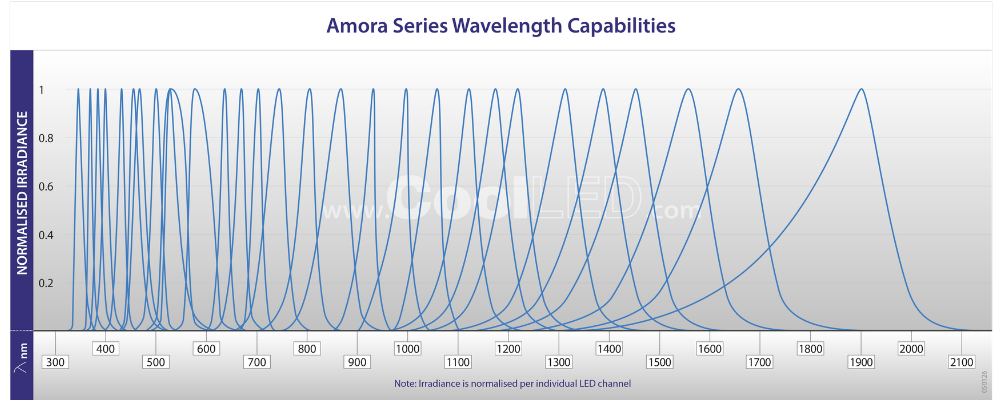
LED illumination platforms can be configured with multiple independently controlled channels, enabling rapid wavelength switching within a single illumination unit. This multispectral capability spanning UV to SWIR (Figure 1) replaces multiple discrete sources or complex monochromator/filter-wheel arrangements, in a single, electronically controlled platform, reducing tool complexity and integration cost.
2.2 Stability, Uniformity and Image Quality
Measurement confidence depends on illumination consistency. Arc and halogen sources are inherently variable: arc wandering, plasma fluctuation, electrode erosion and bulb ageing all introduce drift that demands frequent recalibration. A well-engineered LED system eliminates these failure modes, leading to robust, repeatable data:
• Short-term stability: electronically regulated current drive achieves intensity variation of less than 1%.
• Long-term stability: LEDs maintain output over tens of thousands of hours (typical rated lifetime >25,000 hours), eliminating the recalibration cycles and recipe re-qualification triggered by lamp replacement.
• Thermal stability: LED’s generate significantly less heat than lamps, reducing the thermal load and rapidly reaching thermal stability.
• Spatial uniformity: combined with well-designed secondary optics, LED systems deliver inherently homogeneous and stable illumination across the field of view, reducing post-processing burden and improving the signal-to-noise ratio available to defect detection algorithms, leading to increased yield and throughput.
• Speckle-free imaging: unlike lasers, LEDs are incoherent and do not produce speckle.
2.3 High-Speed Electronic Control and Synchronisation
Modern inspection tools operate at high throughput, with continuous wafer stage motion and tight integration between illumination, imaging and stage control. LEDs can be switched and modulated on microsecond timescales, enabling:
• Pulsed illumination: synchronised with camera exposure to freeze motion and eliminate blur in high-speed scanning; fully compatible with Time Delayed Integration (TDI) sensor architectures.
• Multi-channel sequential acquisition: rapid wavelength switching allows multispectral image stacks to be acquired without mechanical filter changes, increasing throughput and eliminating moving part failure modes.
• TTL / analogue triggering: direct integration with tool system controllers eliminates timing jitter between illumination and image acquisition, a critical requirement for sub-micron metrology.
3. Technology Comparison
4. About The CoolLED Amora Platform
CoolLED has been at the forefront of LED illumination technology since introducing the world’s first commercially available LED illuminator for life science microscopy in 2006.
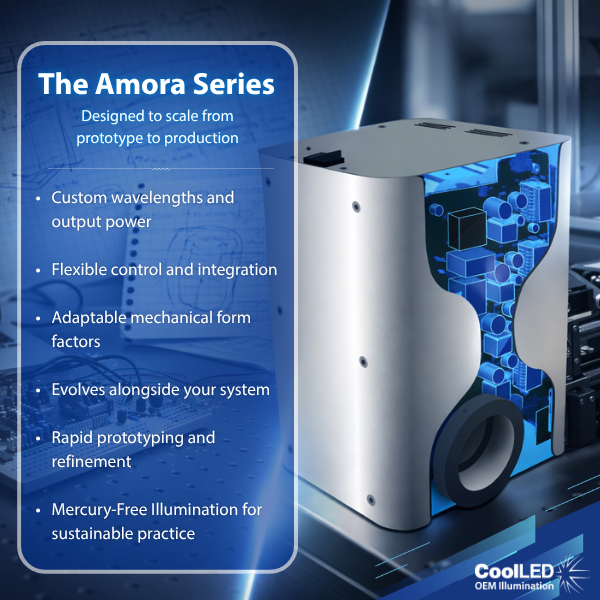
The Amora Series is CoolLED’s OEM LED illumination platform, purpose-engineered for demanding optical instruments where stability, spectral purity and fast switching are paramount.
Key specifications
• Wavelength coverage: 300–1900 nm (High power UV, Visible, NIR and SWIR LED’s in a single platform)
• Up to 10 independently addressable LED channels, configurable to specific wavelength requirements
• LED dies selected for tight wavelength specification control
• TTL and analogue triggering with microsecond response times
• Fibre optic, liquid light guide or direct optical output
• Integrated thermal management for long-term stability and extended lifetime
• Custom SDK and standard instrument control protocol support
• Compatibility: enabling retrofit into existing tool designs without full redesign
Application coverage across the semiconductor workflow
• Front-end (FEOL) wafer inspection: UV and visible for particle detection, scratch mapping and contamination analysis
• Photolithography alignment: narrowband visible with high wavelength stability
• Mid-end (MEOL) AOI and pattern inspection: multi-wavelength for spectral contrast optimisation
• CD and overlay metrology: stable narrowband UV and visible for scatterometry and imaging
• Back-end (BEOL) and advanced packaging: NIR and SWIR for subsurface inspection, solder bump analysis and 3D packaging verification
|
Summary The case for LED illumination in optical semiconductor inspection and metrology is now compelling, both technically and commercially. LED sources deliver superior stability, spectral selectivity, speckle-free imaging and high-speed electronic control, contributing to higher inspection sensitivity, increased throughput and reduced downtime. The shift to advanced packaging and heterogeneous integration has made NIR and SWIR illumination capability a core requirement for next-generation inspection tools. And LED platforms such as the CoolLED Amora Series are uniquely placed to deliver this across a single, configurable architecture. The economics reinforce the technical argument: improving yield and throughput, eliminating lamp replacement cycles and the associated recalibration overhead produces a measurable and sustained reduction in cost of ownership. |