



From Cues to Cravings
How the pE-400max is shedding light on the neuroscience of food-seeking behaviour
Eisuke Koya, Ph.D – Professor in Behavioural Neuroscience – University of Sussex
Professor Eisuke Koya leads a research group at the University of Sussex, where his laboratory studies how environmental cues associated with food can trigger behaviours such as food seeking. He explains his research and the role of the CoolLED pE-400max LED Illumination System.
Animals and humans have evolved to respond to environmental signals known as cues, which enable individuals to seek out nutrient sources essential for survival.
For example, a shark detecting the scent of blood associates it with the likely presence of prey. From a scientific perspective, understanding this process is fascinating. In humans, however, this topic of study also has benefits for public health, since cues can drive food cravings, sometimes contributing to overeating when food is readily available.
Fast food advertising serves as a prime example, constantly exposing us to powerful food-related cues. In fact, public health policies are beginning to address the issue, and the UK government has started restricting advertisements for junk food.
We learn about these food associations almost subconsciously, and the process happens rapidly which is an advantage for survival. Once established, these associations are powerful and long-lasting. While we may forget what we had for lunch two days ago, the connection between a fast-food logo and a hamburger can persist for years.

My area of research studies these cues at the neurological level, where food-related cues activate specific neurons, provoking cravings or food seeking behaviours. The idea behind my research is that we present the cue and observe which neurons in which brain regions become active – for example, those regions associated with motivation and reward. These areas are likely where memory associations are stored. This is a favourite aspect of my research, but a more recent interest is how responses to food-related cues might be controlled.
Many studies focus on how cues provoke reactions to cravings, but it’s equally important to study how the brain can stop responding to those cues. We already know that being sedentary seems to increase vulnerability to cravings, and cognitive stimulation approaches such as listening to music or going for a walk are known to reduce these.
But how can we increase control, and can we harness anti-food neuronal craving circuits in the brain to help individuals reduce their cravings?
Importance of Immunohistochemistry
Fluorescence microscopy is heavily used in our research, especially for immunohistochemistry which allows us to identify activated neurons. We do so by detecting neurons that express the activation marker ‘Fos’ and thus switched on by food-associated cues, and determine which regions of the brain these are found.
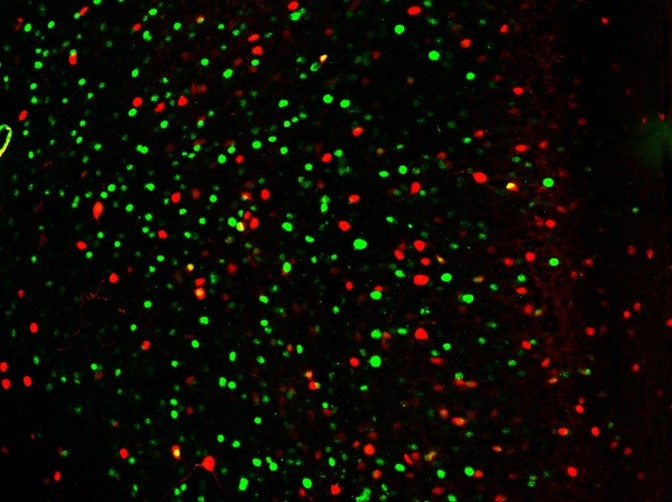
Once we have located activated neurons, we can then determine the identify of these neurons. For instance, we can stain for a chemical marker which can identify an ‘inhibitory’ neuron that dampens activity of other neurons. In the picture (Figure 1) the activated neurons that express Fos are green and the inhibitory neurons express a red fluorescent protein.
(Figure 1 – Immunohistochemistry showing activated neurons expressing Fos (green fluorescent protein) and inhibitory neurons (marked with red fluorescent protein). Fluorescence excitation achieved with the CoolLED pE-400max)
We also employ an additional technique called fibre photometry, which uses calcium-sensing proteins, such as GCaMP to measure calcium activity in vivo, in real time. Thus, we can observe a live broadcast of neuronal activity when cues are presented, as calcium activity occurs when neurons are stimulated and become highly active. Once we acquire the calcium activity trace, staining the brain tissue slices and analysing these using immunohistochemistry provides more information.
For example, are the neurons close to the optic sensor expressing GCaMP, and is the fibre close enough? Or if signal was absent, we can check whether the GCaMP protein is expressed in this region. Fluorescence microscopy confirms whether we recorded calcium activity in the correct region of the brain.
Fluorescence Microscopy Upgrade
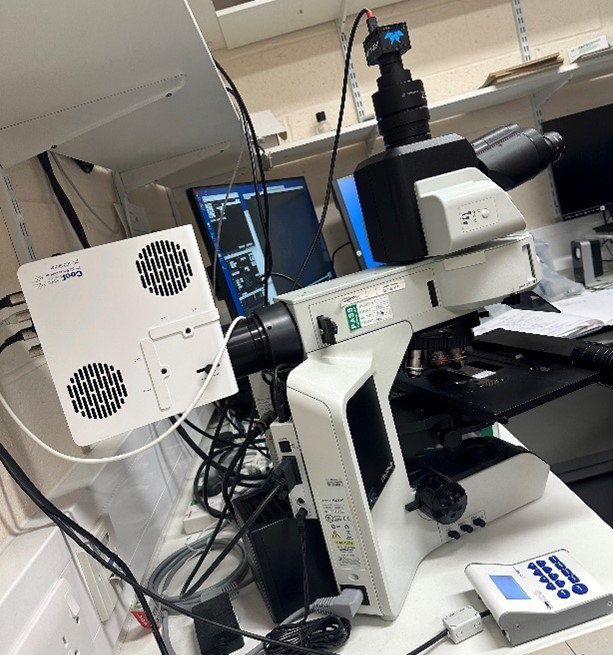
We rely on our widefield fluorescence microscope for analysing immunohistochemistry (Figure 2), and this system previously had a metal halide lamp for fluorescence illumination. However, when the lamp broke down, instead of repairing the unit, it was more economical to replace it instead – and LED technology is now the go-to choice. Based on the CoolLED transmitted light source we already had for many years, which is both powerful and robust, we opted for another CoolLED Illumination System.
The new four-channel pE-400max is quiet and significantly brighter, allowing improved visualisation of our proteins of interest, especially through the eyepiece which provides a wider field of view. This extra brightness is especially useful for natively fluorescent proteins in bioengineered mice, where neurons autofluorescence when excited with certain wavelengths of light.
The more powerful the light, the better the detection, which provides us with greater insights into neuronal activity in response to cues.
(Figure 2 – CoolLED pE-400max on the Evident BX53 microscope)

CoolLED specialises in LED microscope lighting and, since our team of four introduced the first commercially available LED microscope illuminator in 2006, we have led the way in designing and manufacturing cutting edge LED Illuminators for Microscopes using the latest technology.
