


2027/02/24 11:58:42
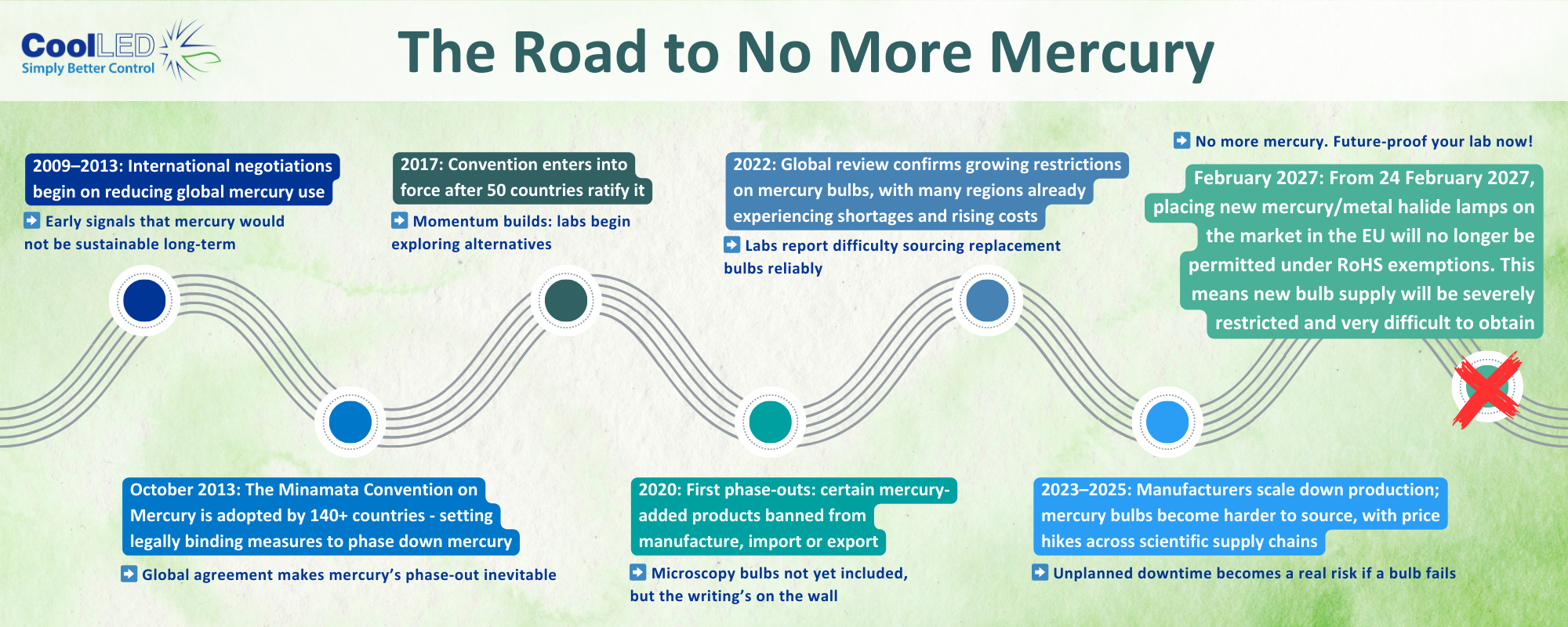
No More Mercury: What the 2027 Mercury & Metal Halide Phase-Out Means
From February 2027, new mercury and metal halide lamps will be far harder to source in the EU so planning ahead protects uptime and budgets.
-
What’s changing: You can keep using existing systems, but from 24 February 2027 the sale/import of new mercury-based replacement lamps into the EU is expected to be heavily restricted as RoHS exemptions expire.
-
What’s not changing: your existing system doesn’t become illegal overnight.
-
Why act now: shortages, rising costs, and downtime risk will increase as 2027 approaches.
In simple terms: you won’t be forced to switch your system off but replacing bulbs will get harder, slower, and more expensive.
No More Mercury: Mercury Phase-Out 2027
The Mercury and Metal Halide Lamp Replacement & LED Alternatives
Mercury and metal halide bulbs have lit up labs for decades, but their time is nearly over.
While existing systems will not be switched off overnight, the ability to purchase and replace mercury-based bulbs will become increasingly restricted from 2027.
Some are framing it as a ‘mercury bulb ban’ but mercury lamps won’t be illegal to use after 2027, it’s more a case that new bulbs will no longer be manufactured or placed onto the market, and will become increasingly hard to source and vastly more expensive than they are now.
By 24th February 2027, mercury-based illumination will no longer be a viable long-term option for most laboratories.
In simple terms: you won’t be forced to turn your system off, but replacing mercury bulbs will become increasingly difficult and unreliable after February 2027.
This page is for laboratories, OEMs, system builders, and facilities using mercury or metal halide illumination who need to understand what’s changing and how to prepare. You don’t need to change everything today. You just need a plan.
Jump to:
How to prepare | Calculator | LED alternatives | FAQs | Resources for Resellers | Contact Us
This page provides general guidance based on current regulations and industry guidance.
Local requirements may vary. Always consult your supplier or regulatory authority for formal compliance
Does the 2027 Mercury and Metal Halide Bulb Phase-Out Affect my Application Area?
Yes life science, materials science, and industrial inspection are all affected
The 2027 phase-out isn’t about whether you’re “allowed” to use your current microscope or inspection system. It’s about the availability of mercury-containing lamps and replacement bulbs, which impacts any workflow that still relies on mercury or metal halide illumination regardless of the application.
Life Sciences (Fluorescence Microscopy)
Many fluorescence microscopes still use mercury or metal halide lamps for routine imaging and multi-colour fluorescence. As lamp availability tightens, the risk is unplanned downtime, rising bulb costs, and uncertainty around future supply. LED illumination offers stable output, instant on/off control, and a straightforward path away from consumable bulbs.
Materials Science (Microscopy & Analysis)
Materials science systems often run long hours and rely on stable illumination for consistent imaging and analysis. If your workflow depends on mercury or metal halide lamps, the phase-out can affect continuity of testing due to replacement lead times and supply variability. Planning a transition helps protect uptime and repeatability.
Industrial Inspection (Machine Vision & Metrology)
Industrial inspection and machine vision environments typically prioritise stability, uniformity, and uptime. Mercury and metal halide lamp systems introduce supply risk and variability as bulbs age. Moving to LED supports predictable operation, faster control (including triggering), and reduces dependence on lamps that may become harder to source.
How to Prepare for the Mercury Phase-Out in 3 Simple Steps
Preparing early removes uncertainty, protects your workflow, and avoids rushed decisions later.
Step 1 – Assess your risk
Understand how exposed your facility is to mercury-based illumination
-
Do you currently rely on mercury or metal halide lamps?
-
How often do you replace bulbs?
-
Do you know how long your current stock would last?
-
Have you experienced price increases or longer lead times?
-
Do you have a backup plan if supply suddenly becomes unavailable?
Step 2 – Plan your future illumination
Decide how and when you want to move away from mercury
-
You don’t have to replace everything overnight
-
You can phase the transition to match budgets and workflows
-
You can test LED alternatives alongside existing systems
-
You stay in control of timing and cost
- You can involve your team early to validate performance and workflow impact
Step 3 – Choose the best CoolLED solution
Select a long-term, mercury-free illumination system
-
LED removes dependence on consumable bulbs
-
Provides stable, repeatable output
-
Simplifies maintenance
-
Future-proofs your system
- Ensures long-term availability and support
Calculate how long your current mercury / metal halide bulb stock will last
Takes less than a minute. No data is stored.
Why Switch to CoolLED?
Going mercury-free isn’t just about compliance. It’s about sustainability and smarter science.
The ACT Label (Accountability, Consistency, Transparency) is often described as a “nutrition label for lab equipment.” It is managed by My Green Lab and independently verified by a third party. Products are scored on manufacturing, energy and water use, packaging, end-of-life disposal, and corporate responsibility. Achieving certification shows that CoolLED products meet strict environmental standards across their full lifecycle.
EcoVadis provides one of the world’s most trusted business sustainability ratings. Companies are assessed across four themes: Environment, Labour & Human Rights, Ethics, and Sustainable Procurement. Earning a Bronze medal places CoolLED in the top 35% of companies assessed worldwide, recognising our ongoing efforts to improve environmental and social responsibility across our entire business. You can view our official assessment here
We’ve been pioneering mercury-free LED Illumination since 2006 – reducing energy use, cutting waste, and eliminating hazardous materials. We understand the realities of replacing mercury and metal halide because we’ve been doing it for nearly 20 years, across routine fluorescence, advanced imaging, and demanding facility environments. We’ve helped thousands of users transition by matching illumination to their stains/fluorophores, microscope platforms, control requirements, and uptime needs. It’s not about forcing a change overnight, it’s about future-proofing performance and availability with a proven alternative.
Your Mercury-Free Alternatives
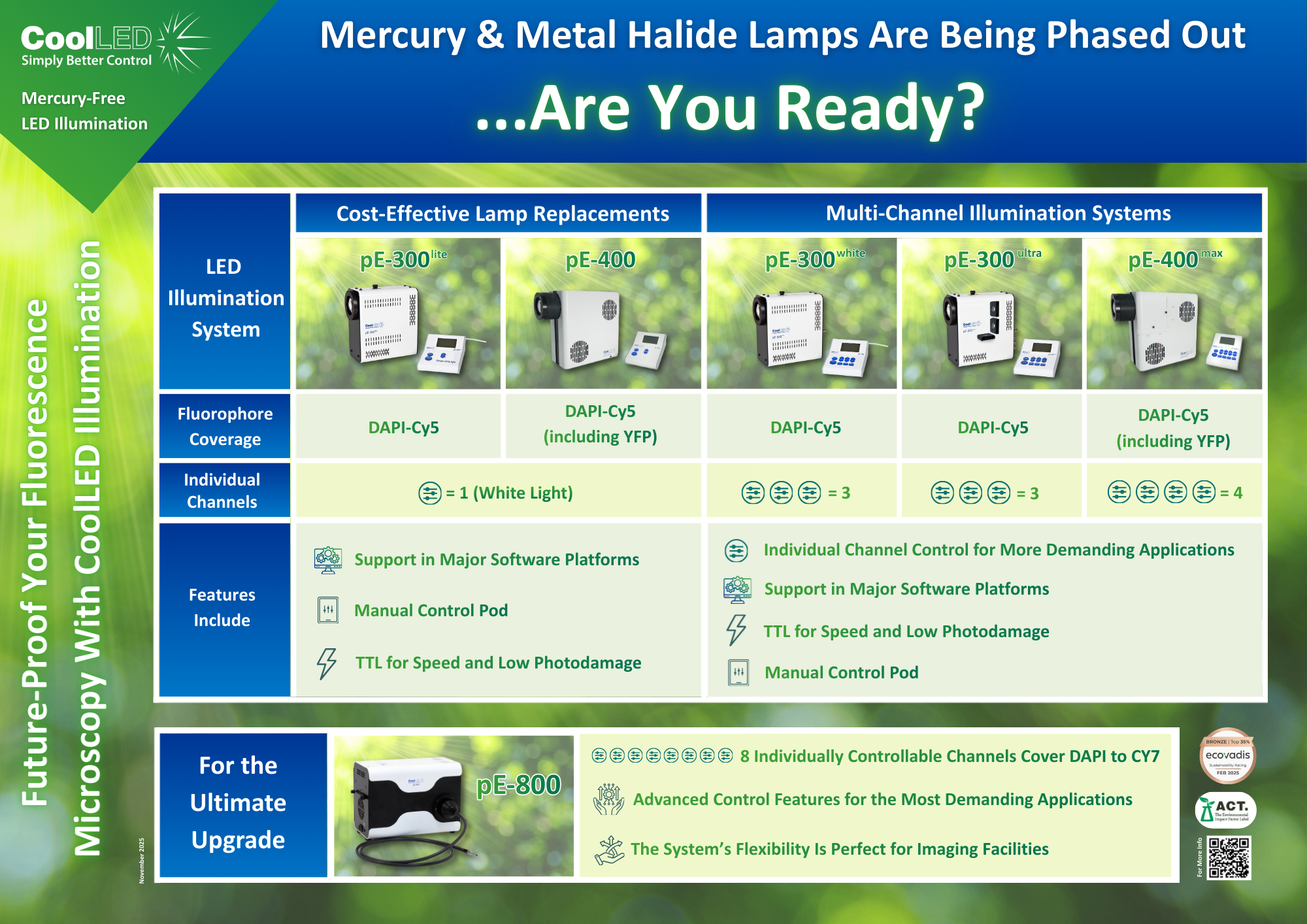
CoolLED LED Illumination Systems are the ready-made replacements for mercury bulbs – safer, energy-efficient, and simple to install.
These systems are designed as direct replacements for mercury and metal halide lamps, without requiring changes to your microscope.
For everyday fluorescence microscopy
-
pE-300lite – White light, simple on/off control, covers DAPI, FITC, TRITC, Cy5
-
pE-400 – Four-channel white light replacement, USB or TTL control, flexible and affordable
For more advanced applications
-
pE-300white – Broad white spectrum, ideal for transmitted light and fluorescence
-
pE-300ultra – Independent channel control, software integration, precise wavelength selection
-
pE-400max – Superior coverage for CY5 and red wavelengths, four powerful LED channels, USB/Ethernet/TTL control
The ultimate upgrade
-
pE-800 – Eight powerful channels, fast switching, advanced control via software, TTL or USB/Ethernet. Perfect for complex imaging setups
What this means for your facility:
-
Lower energy consumption and substantial savings in running costs
-
Safer disposal with no hazardous mercury waste
-
Reduced heat output, protecting samples and extending microscope life
-
Easy compliance with sustainability audits and reporting
-
Confidence that your supplier is independently verified for environmental and ethical responsibility
By switching, you’ll not only remove mercury from your lab, but also support wider global sustainability goals.
Mercury & Metal Halide Bulb Phase-Out – Frequently Asked Questions
The 2027 mercury phase-out is often described as a “ban”, but the reality is more nuanced than that. It affects how mercury lamps are supplied, not whether existing systems can continue to operate. This distinction is important, and it’s where much of the confusion comes from.
These FAQs are here to provide clear, practical answers to the questions we hear most from labs, facilities, resellers, and system builders. They explain what is changing, what is not changing, and what it means for the future of illumination in real-world use.
Act Now – Don’t Wait Until 2027
Future-proof your lab equipment
Trial a system today with a loan unit
Talk to our team about the best replacement for your facility
