


Chroma Technology Corp leads the way in developing advanced optical filters
When it comes to achieving perfection in fluorescence microscopy, ensuring all the components of the light path work in harmony is crucial.
We spoke to Senior Applications Scientist at Chroma Technology, Dr Michael Stanley, for his views on the performance gains possible from matching optical filters and illumination.


What is your role at Chroma?
At Chroma, we manufacture a variety of different optical components, with the largest application sector being optical filters for fluorescence microscopy. We also cover a range of application areas from astronomy to machine vision, and in total offer around 21,000 unique filter designs.
I work on the application side, where I teach our customers how to use optical filters and get the best from their experiments. Scientists live in a specialised world, training for years to become highly focused in their area, and don’t always have the time to understand the surrounding technology in depth. While optical filters might just be a small component in a giant system, image quality can benefit from better understanding, especially when it comes to matching the filter, light source and fluorophore selection.
For this reason, I’ve always been keen to include a true teaching component in my role, and Chroma as a whole has made a substantial effort over the last 15-20 years to inform and educate anyone who contacts us about fluorescence and imaging, without the aim of selling. As far as I know, we are unique in spending the resource to teach and train without asking for anything in return. In fact, I was a teacher for many years when I started my career, before completing a PhD in cellular biology. I gradually became more involved with the technology (which being in cellular biology, mainly involved microscopes), and had known Chroma for many years due to using their filters. It was 29 years ago when I first moved away from academia and joined Chroma, and I’m very happy. I was employee number 28, and the company was so small that every one of us helped shape how Chroma is today.
How do optical filters work?
With optical filters for fluorescence microscopy, these small pieces of glass are treated with different coatings, which are very specialised and unique. Each coating material has its own refractive index, creating a unique interference pattern which only permits light of certain wavelengths, while blocking others – optimising the light path for imaging selected fluorophores. You see these interference patterns all the time in the outside world, where tinted windows have a different colour, or if a window has a scratch. Depending on which angle you view it from, a bright colour or flash of white might appear.
Designing coatings and filters is an ongoing process, keeping an eye on emerging technologies, but also investigating whether older technologies can be improved.
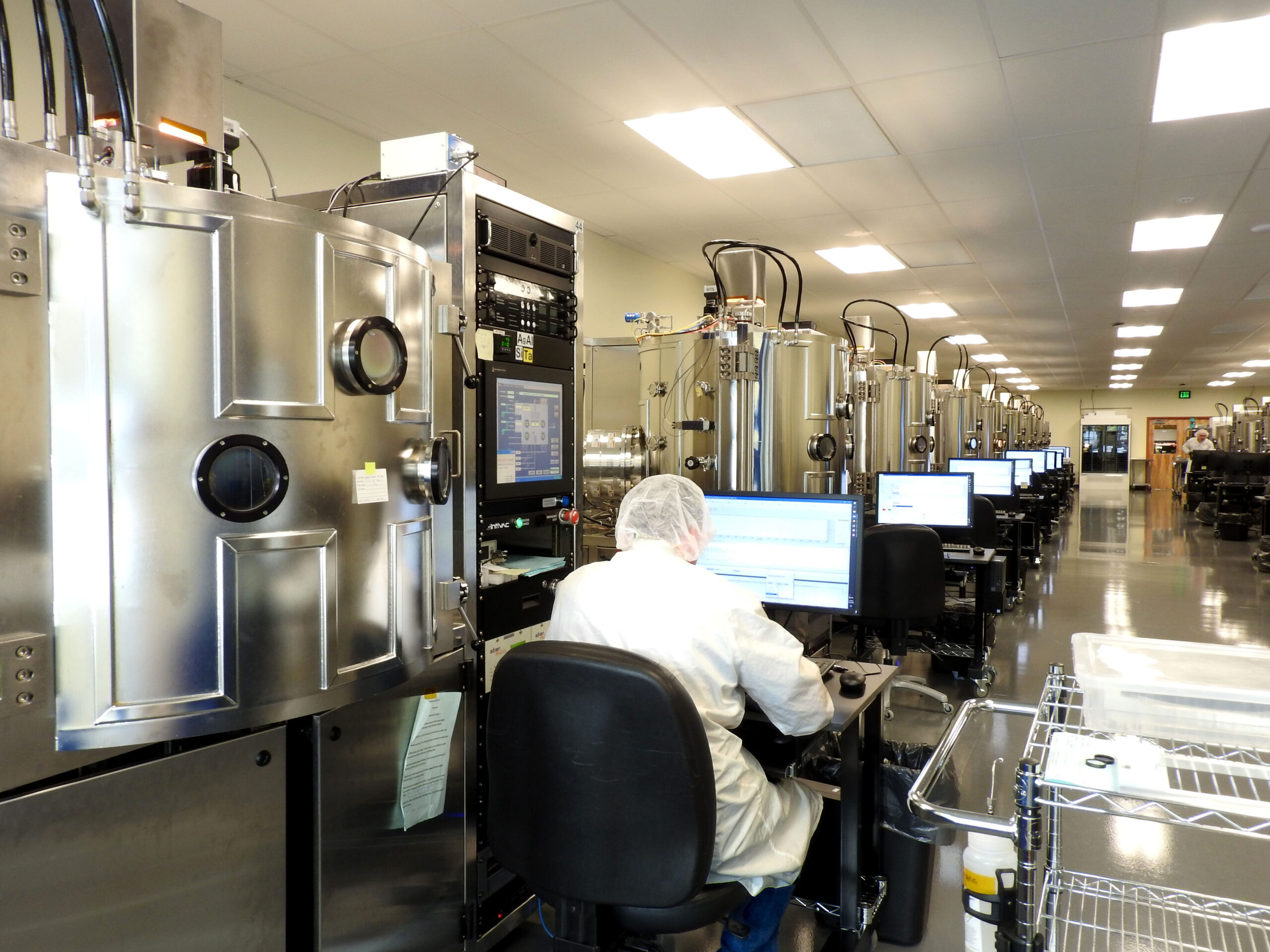
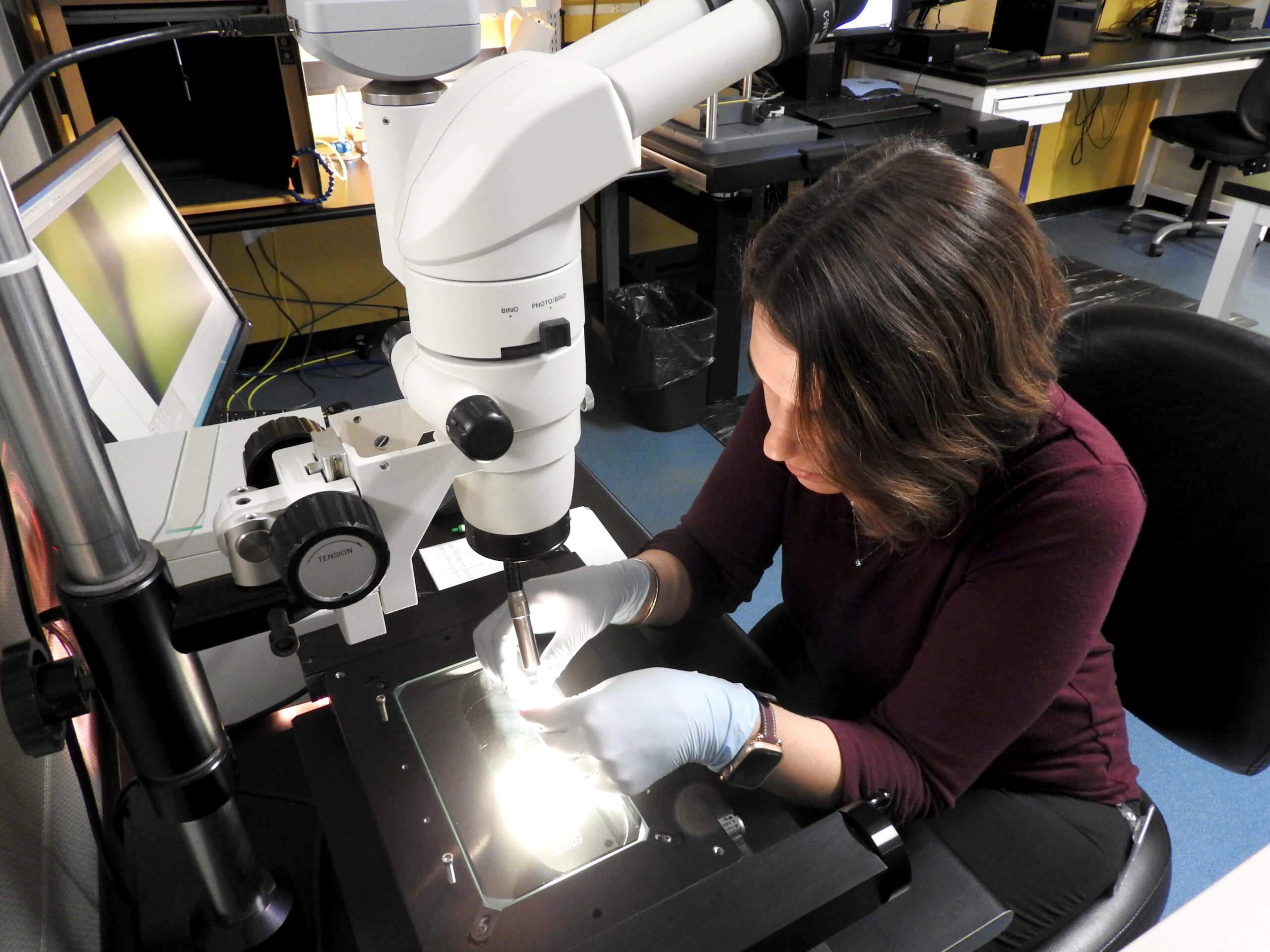
Optical filters at Chroma Technology are carefully manufactured using sophisticated coating methods
How does the light source impact optical filters?
When I started working with fluorescence microscopy, the default light source was a mercury lamp. I only had to consider the three fluorophores most commonly used throughout life science research, as others were poisonous or didn’t work.
Optics were originally limited by being designed around the human eye (because the human eye was the detector in the first microscopes), and the development of cameras opened up regions of the spectrum to new fluorophores.
Then LEDs became available for fluorescence microscopy, and it was a challenge in the beginning. They had been on my radar for a while, and I distinctly remember that CoolLED was the first commercial LED light source I was able to try. Firstly, the variety of LED colours meant we had to create filters for different wavelengths. This has been part of our toolkit forever and so we adapted quickly to that aspect and our filter range now covers a huge number of fluorophores across the spectrum. Another challenge to overcome was how LEDs emit light at a very high angle. The coating layers of optical filters are angle-dependent and work beautifully up to around 10 degrees. One of the aspects that CoolLED addressed very quickly was collimation, which is crucial for optical filters to work. I was playing with a light fibre and shining the light across three meters, and the light spot was still a small circle – which you can do with lasers all the time, but with other light sources, that’s not a trivial achievement.
LEDs are here to stay, with the great advantage being the ability to manipulate the wavelengths to match the spectral regions most fluorophores absorb at. The colours are bright, can be turned off and on at high speed and last a long time. You can also change the power ‘on the fly’. With mercury, you could decrease it, but this required an optic; you couldn’t do it electronically. For good image quality, illumination output needs to be both consistent and stable, and the spectrum must be well profiled – which CoolLED has achieved.
What is your best advice for scientists using fluorescence microscopy?
When it comes to troubleshooting or getting the best results from an experiment, this requires looking at the beam path. That was how I was taught and what I still tend to teach now. We need to start from the beginning: the light source being used makes a huge difference in whether or not the system will even work.
It’s not always widely understood that the filters need to be matched to the LEDs, and vice-versa; even though a filter and fluorophore might be supposed to work with a range of light sources, they won’t offer the same performance for all light sources and individual wavelength ranges.
The illumination has to be the right wavelength and offer enough power for the particular application. It’s important to make sure the right filters are installed, because if you have the wrong filter for your light source and fluorophore, the imaging just won’t work. These components are valuable, and it makes sense to use the equipment already available. But sometimes a few nanometres difference is a lot when it comes to wavelengths and optical filters. Although small, the name and part code are specified on the filter, which is useful for checking performance using the Chroma Spectra Viewer tool.
I also see fluorophores being destroyed by too much power, and so it pays to be careful and avoid photobleaching and phototoxicity – optical filters don’t suddenly stop working; one of the aspects we focus on is ensuring the materials remain robust over time. The most likely scenario is a bleached sample, so that’s why the first step is to address the light source and power.


What are future developments for optical filters?
There are two main themes I often hear about and receive questions about. The first relates to the variety of wavelengths and moving into the longer area of the spectrum. This has its advantages for some applications, but has its drawbacks for others, and there is always a trade-off to consider. The second theme relates to imaging speed, with the trend towards faster acquisitions. For example, when observing samples in motion, twice the speed means double the data, and that requires brighter illumination which is facilitated by the light source itself but also by optimised filters.
How have you worked alongside CoolLED?
It’s very important for us at Chroma to work closely with a light source manufacturer and develop filters that improve performance of LEDs. For these projects, I work alongside CoolLED’s Key Account Manager Brad Reynolds, which has been a great working relationship. He’s bright and fun to be around so that makes it really easy in that sense. He sets out the requirements, and we select filters to match these.
He’s been very honest, especially in the early days with the collimation challenge and the power differences in LEDs across the spectrum, so we could work around these and make the combination of LED and filter work for a given fluorophore.
When I’m working on collaborations like these, I appreciate that someone might not have all the exact answers at the time, but they go and find out and get back to me. CoolLED, including Brad and the engineers, have done that repeatedly for me.

Chroma filters optimised for CoolLED LED Illumination Systems can be found on the CoolLED Filter Finder Tool.
About Chroma
Chroma manufactures high-performance optical filters covering a spectral range from 200-3000 nm with superior durability and longevity, across many industries and applications. Filter types include long, short, and multi-bandpass filters, notch rejection filters, neutral density filters, beamsplitters, and reflective metal mirrors.
Chroma offer off-the-shelf, custom, and high-volume production products and solutions, we can design and deliver optical filters that do precisely what our customers need.
