A Day in the Life of a Fluorophore
Fluorescence microscopy (and the excitation of specific fluorophores) can sometimes seem confusing, but the reality is much easier to imagine if you think of fluorophores as small, colourful employees working the world’s most demanding shift pattern, who just need a bit of gentle encouragement throughout their day.
They spend their days absorbing specific wavelengths of light, glowing brightly in response, and then trying not to burn out from the workload. Here’s a simple walk-through of what fluorophores actually do and why the right illumination matters so much.
Morning: The Excitation Wake-Up Call
Every fluorophore has its own preferred “alarm clock” which means a precise wavelength that wakes it up.
Take GFP for example. It springs into action when hit with around 488 nm (blue-green light). Once excited, it emits green light at about 509 nm. This is its entire job description: absorb one colour, emit another.
Other fluorophores have their own routine:
-
DAPI only responds to UV/violet light around 358–405 nm, glowing a bright blue.
-
mCherry prefers ~587 nm and emits a deep red ~610 nm.
-
Cy5 needs ~640 nm to get started and shines in the far-red ~670 nm.
It’s like a team of workers who only function if you shout their favourite colour at them.

Lunchtime: Working with Colleagues
In many experiments, multiple fluorophores work side-by-side. This is where things get interesting.
A typical multicolour experiment contains dyes that need:
-
UV excitation (e.g. DAPI)
-
Blue-green excitation (e.g. GFP)
-
Yellow/orange excitation (e.g. mCherry)
-
Deep red excitation (e.g. Cy5)
Keeping them all happy at the same time requires precise wavelength control; otherwise, you accidentally excite the wrong one and create a fluorescent argument on your slide. This is why narrow, well-defined LED wavelengths are so helpful.

Afternoon: The Perils of Overworking
Fluorophores are hard workers, but they’re not invincible.
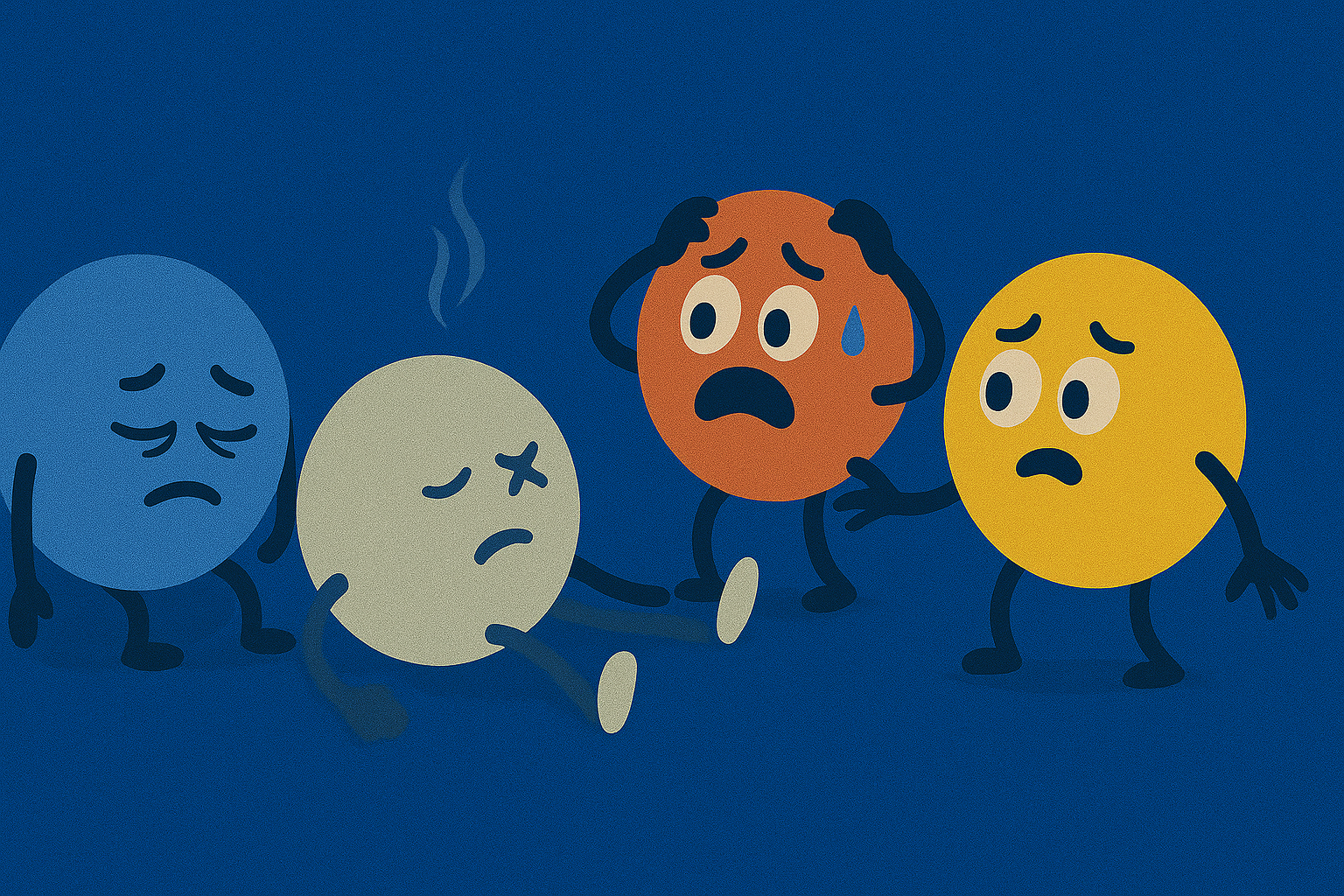
If you blast them with too much light for too long, they undergo photobleaching which is the fluorescence equivalent of an old metal halide bulb quietly giving up.
Photobleaching is caused by:
-
excessive illumination / high-energy wavelengths / unstable or drifting light sources / sample heating
It’s essentially the fluorophore saying: “I’ve glowed my last glow. I’m done. Let me die in peace…”
Using controlled, stable illumination helps keep them functioning longer which is particularly important during long time-lapse or high-intensity imaging.
What We Can Learn from Their “Day”
Fluorophores are simple creatures: give them the right wavelength, treat them gently, and keep the illumination consistent, and they’ll reward you with clear, reliable fluorescence.
But change the wavelength slightly, introduce drift, or crank up the heat, and the whole setup becomes harder to interpret; not because the biology changed, but because the lighting did.
Understanding this “day in the life” doesn’t just make fluorescence easier to grasp; it reminds us that behind every image is a tiny worker doing its best under the lighting conditions we provide.
Written by Ben Furness / [email protected] / LinkedIn Profile