Driving advances in spatial biology with a successful OEM partnership
Spatial biology is a popular area of study for good reason – molecules don’t function in isolation, and understanding the ‘bigger picture’ provides unprecedented insights into physiology throughout both health and disease. Critically, current spatial biology platforms tend to assess protein expression instead of protein functional states. This is important, since it is the functional states that provide druggable targets and drive disease progression, rather than protein expressions alone.
Hawk Biosystems has developed an innovative and user-friendly technology, QF-Pro®, for studying protein functional states, such as protein-protein interactions (PPIs) and protein post-translational modifications (PTMs) in fixed samples. This is run on their user-friendly fluorescence lifetime imaging microscope, Violet 3.0., which utilises a modulated diode laser and is also complemented by LED illumination for routine immunofluorescence mapping.
We spoke with Dr James Miles, Product Manager at Hawk Biosystems, who explained the role of LED illumination and the partnership between the two companies that made it possible.

Tell us about Hawk Biosystems and your role with its technology?
I joined Hawk Biosystems initially as a placement student during university, and I’ve been working with the technology for nearly a decade now. As Product Manager, my key role is transforming the technology into tangible products for lab scientists, and this founding technology is QF-Pro®, which stands for Quantifying Functions in Proteins.
Quantification of proteins or biomarkers, and even co-localisation, doesn’t always correlate with physiological outcomes. Our technology addresses this limitation by also analysing protein functionality, which provides much greater insights for many different studies of the ‘interactome’. It is possible to observe whether two proteins are interacting, or whether one has become activated or inactivated by various mechanisms. We can also quantify protein-DNA interactions.
The underlying technology of QF-Pro relies on Fluorescence Lifetime Imaging Microscopy (FLIM) and Förster Resonance Energy Transfer (FRET), re-invented and with a fourfold increase in signal-to-noise ratio to make it work robustly and reliably. But perhaps the most significant aspect is making it accessible to biologists in the form of the Violet 3.0 platform, allowing life science researchers to focus on biological questions rather than specialist methodology.
How do multiple imaging techniques work together?
Whilst QF-Pro analyses the interaction state of two biomolecules, providing background context for these interactions is also important. For example, in the field of immuno-oncology, when studying an immune checkpoint and analysing the interaction between the immune system and a tumour, it is possible to assess areas of a sample positive for a biomarker of interest.
However, by including an LED-based immunofluorescence module to the device, it is possible to create maps of interest using secondary biomarkers of interest.

In this example, the functional interaction of an immune checkpoint can be quantified, but only on CD3+ cells. Such visualisation of proteins or the nucleus is achieved using immunofluorescence with widefield fluorescence microscopy, and our software is now capable of advanced image layering.
The functional QF-Pro profile can be overlaid directly with nuclear staining, as well as FITC, TRITC and Cy5 channels, building a multiplexed intensity image and providing that critical additional layer of information. The CoolLED LED Illumination System excites these fluorophores, and allows the flexibility to image on multiple channels to create a comprehensive map (Figure 1).
What were your requirements for an LED light source?
We used a mercury lamp during the development of our technology, and suffered from the many associated issues surrounding heat generation, bulb replacements and warm-up times. Of course, these aspects do not make for a user-friendly device, which is why we upgraded to LED illumination for the Violet 3.0 platform. While our main requirement for the new light source was to remove the many drawbacks experienced with the mercury lamp, we also needed an affordable and compact system, where the four channels could be customised.
The option of direct coupling the light source was an unexpected bonus, increasing irradiance while saving both space and a degradable component in the system. We heard that directly coupled light sources could cause vibration from the LED fans and cause image artefacts. Instead, the images are pristine, and there is no vibration whatsoever.
Once the collimator is fine-tuned, which is a simple task, we achieve a more homogenised illumination profile compared with the mercury lamp that required realigning, which is a significant advantage for mapping consistency.
How did you work alongside CoolLED?
We first identified companies such as CoolLED offering suitable off-the-shelf LED light sources with a few fluorescence channels either side of our FRET probe spectral range. But the decision to select a supplier also encompassed our working relationship, because without good people, the technology will never translate into a successful end product. CoolLED navigated me through my questions about LED systems, and with Gerry supporting from a technical aspect, and Liz managing the project, this progressed from being an exploratory series of meetings to matching our requirements with the available technology. It naturally developed without too many questions, whilst we felt supported through the process, and our partnership was a natural fit.
CoolLED has also been flexible throughout the process, for example when we altered one of the LED channels. As we progressed with prototyping, it became evident that one channel was on the spectral limit of our detector. It was a straightforward case of arranging a meeting and asking CoolLED to reduce the LED from 740 to 635 nm.
The technical and project support has been fantastic. Our CoolLED light source is great, but working alongside the CoolLED team has been painless, and the way we have worked together is where the real strengths of the company have come to light.
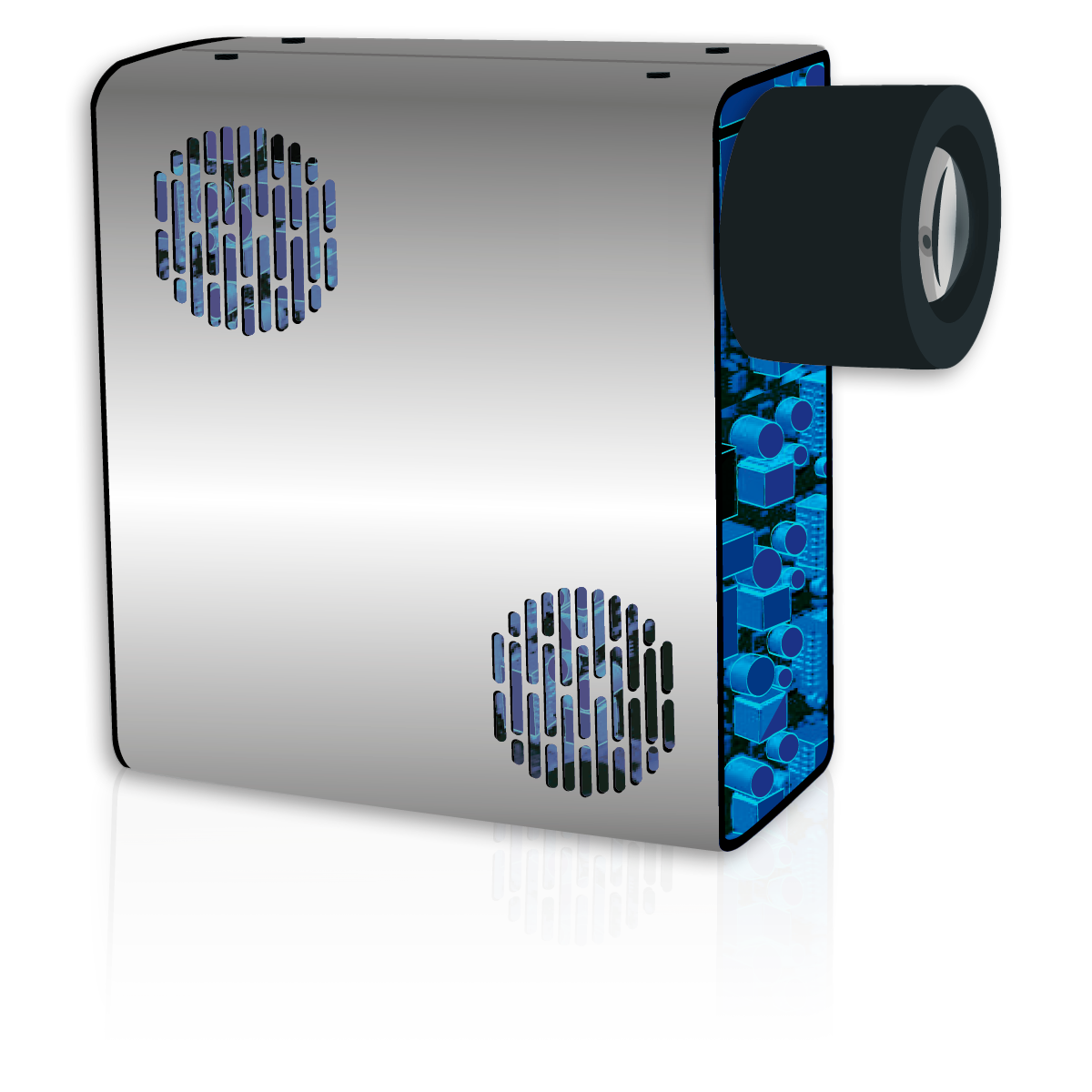
Four-channel Amora four-channel customised LED Illumination System
The CoolLED Illumination System for widefield fluorescence excitation in the Violet 3.0 platform is a four-channel system, with LEDs covering the following spectral regions:
- A UV LED with a centre wavelength of 365 for DAPI staining of the nucleus
- A blue LED with a centre wavelength of 470 nm LED for broad spectrum green fluorophores such as FITC
- A green-red-yellow LED with a centre wavelength of 590 nm for red dyes such as TRITC
- A red LED with a centre wavelength of 635 nm for fluorophores such as Cy5, which has good spectral separation with the FRET acceptor chromophore (Alexa Fluor 594), but is still within the spectral limit of camera detection.